
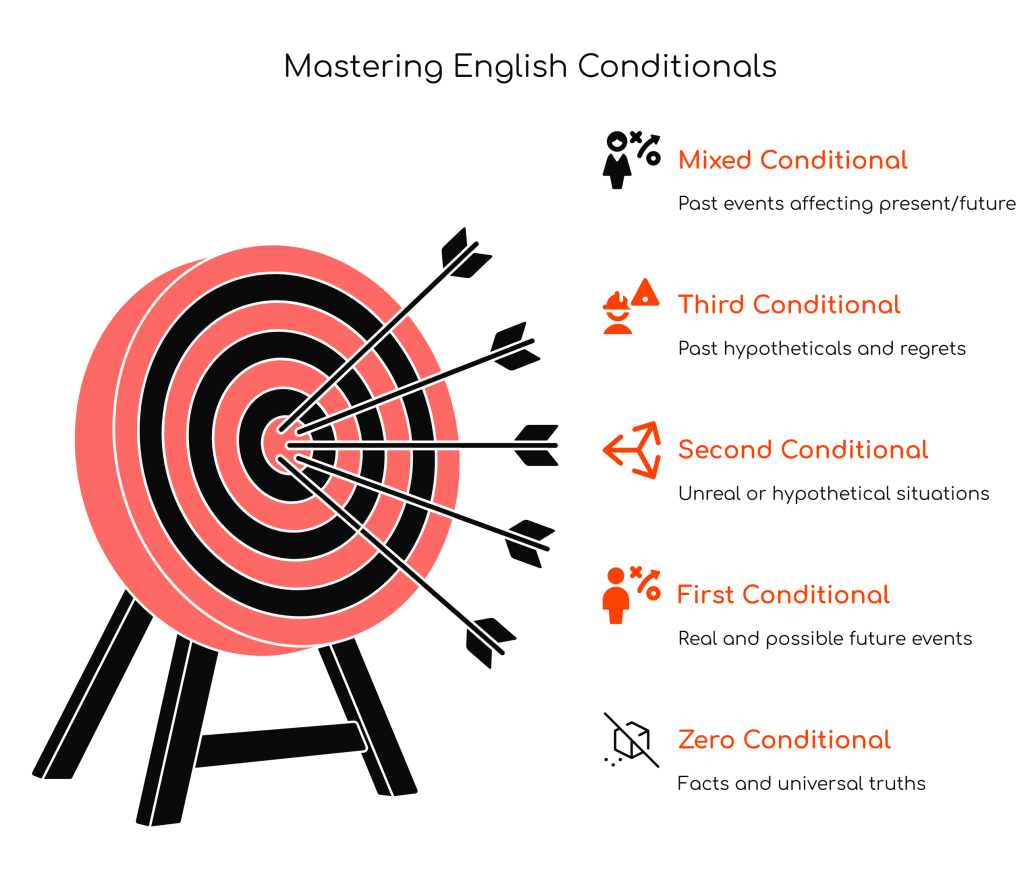
Understanding Conditionals
Conditionals are grammatical structures that describe situations and their possible outcomes. They typically consist of an “if” clause (the condition) and a main clause (the result). Conditionals are classified into five main types, each serving a distinct communicative function.
1. Zero Conditional (General Truths)
Structure:
If + present simple, present simple
Usage:
The zero conditional is used to express general truths, scientific facts, and laws of nature.
Examples:
- If you heat water to 100°C, it boils.
- If you touch fire, you get burned.
- If it rains, the ground gets wet.
Common Errors and Corrections:
❌ If you will heat water, it boils. → (Incorrect: “will” should not be used in the if-clause.)
✅ If you heat water, it boils.
2. First Conditional (Real and Possible Future Events)
Structure:
If + present simple, will + base verb
Usage:
The first conditional describes real and possible situations in the future.
Examples:
- If you study hard, you will pass the exam.
- If it rains tomorrow, we will cancel the picnic.
- If she calls me, I will answer.
Common Errors and Corrections:
❌ If you will study hard, you will pass the exam. → (Incorrect: “will” should not be used in the if-clause.)
✅ If you study hard, you will pass the exam.
3. Second Conditional (Hypothetical Present or Future Situations)
Structure:
If + past simple, would + base verb
Usage:
The second conditional is used to discuss imaginary or unlikely situations in the present or future.
Examples:
- If I were a billionaire, I would travel the world.
- If she studied harder, she would get better grades.
- If it rained in the desert, the plants would grow.
Common Errors and Corrections:
❌ If I was a billionaire, I would travel the world. → (Incorrect: “were” should be used instead of “was” for hypothetical situations.)
✅ If I were a billionaire, I would travel the world.
4. Third Conditional (Past Hypotheticals and Regrets)
Structure:
If + past perfect, would have + past participle
Usage:
The third conditional is used to discuss past situations that did not occur and their hypothetical consequences.
Examples:
- If I had studied harder, I would have passed the test.
- If she had left earlier, she wouldn’t have missed the train.
- If we had taken a taxi, we wouldn’t have been late.
Common Errors and Corrections:
❌ If I would have studied harder, I would have passed the test. → (Incorrect: “would have” should not be used in the if-clause.)
✅ If I had studied harder, I would have passed the test.
5. Mixed Conditional (Past and Present/Future Hypotheticals)
Structure:
Past Condition → Present Result:
If + past perfect, would + base verb
✅ If I had studied medicine, I would be a doctor now.
Past Condition → Future Result:
If + past perfect, would + future base verb
✅ If you had saved money, you would be going on vacation next week.
Usage:
Mixed conditionals describe how a past event influences the present or future.
Common Errors and Corrections:
❌ If I studied medicine, I would be a doctor now. → (Incorrect: “had studied” should be used for past conditions.)
✅ If I had studied medicine, I would be a doctor now.
Frequently Asked Questions About Conditionals
1. Can “when” replace “if” in conditionals?
Yes, but only in zero conditionals.
✅ When you heat water to 100°C, it boils. (Correct)
❌ When it rains tomorrow, we will cancel the picnic. (Incorrect: “when” does not work in first conditional.)
2. Can “was” replace “were” in the second conditional?
In informal speech, “was” is sometimes used, but “were” is the grammatically correct choice for hypothetical situations.
✅ If I were you, I would take the job.
✅ If he were taller, he could be a model.
3. What is the difference between “will” and “would” in conditionals?
- “Will” is used in first conditionals for real future situations.
- “Would” is used in second and third conditionals for hypothetical or unlikely scenarios.
4. Can different conditional types be combined in one sentence?
Yes, mixed conditionals allow for a combination of past and present/future conditions.
✅ If she had studied harder, she would be a doctor now.
Effective Strategies for Learning Conditionals
1. Apply Conditionals to Real-Life Situations
Relate conditionals to personal experiences:
- If I won the lottery, I would travel the world.
- If I had woken up earlier, I wouldn’t have missed the bus.
2. Engage with Conditionals in Music and Film
Listening to songs and watching films can reinforce conditional usage. Consider these examples:
- If I Were a Boy – Beyoncé
- If You Love Me, Let Me Go! – Panic! at the Disco
3. Complete Online Conditional Exercises
Practice through online resources such as Grammarly, British Council, and Cambridge University’s grammar exercises.
4. Participate in Speaking Activities
Engage in conditional-based discussions using prompts such as:
- What would you do if you found a treasure chest?
- What would have happened if you had studied abroad?
5. Write Short Stories Using Conditionals
Challenge yourself to write a short paragraph incorporating different conditional types.
Conclusion
Understanding and using conditionals accurately is essential for effective communication in English. By practicing through real-life examples, engaging with media, and completing structured exercises, learners can significantly improve their ability to express possibilities, hypothetical situations, and consequences with confidence.
Would you like additional exercises or visuals to reinforce these concepts? Let me know how I can assist further.
#IELTS #IELTSGuidePhil #IELTSWriting #Conditionals #GrammaticalRange #GrammarTips #IELTSSpeaking #WritingSkills #IELTSPreparation #StudyEnglish
 IELTS Guide Phil
Leave a comment