
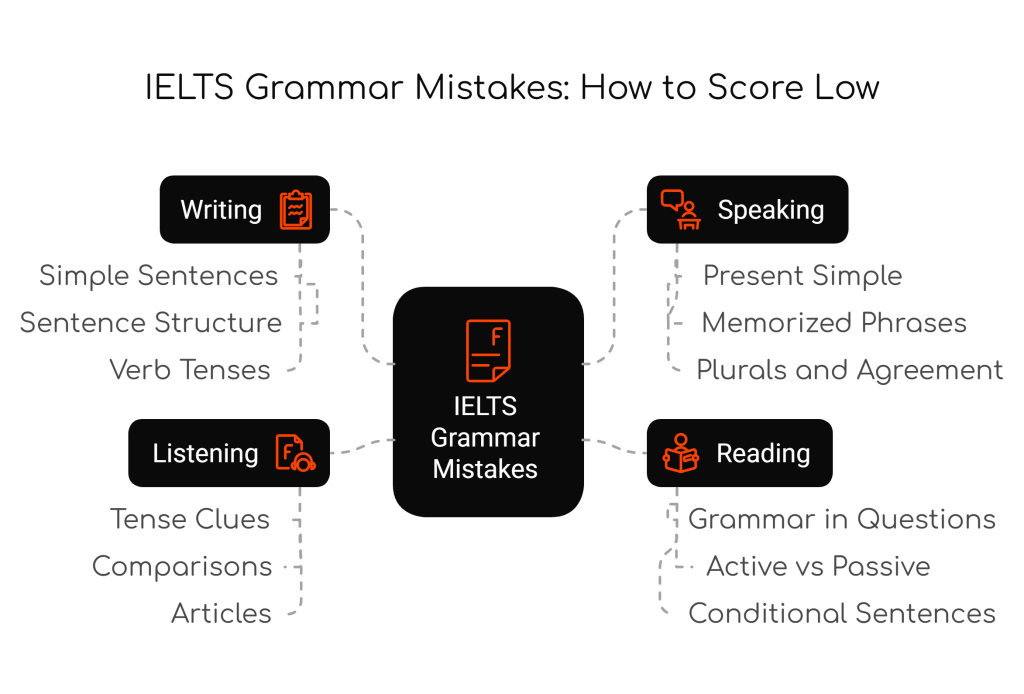
Are you preparing for the IELTS exam but struggling with grammar? If you want to guarantee a low grammar score, just follow the mistakes outlined below.
Of course, if you are aiming for a higher score, you should do the opposite of everything listed. This article will examine the most common grammar mistakes that prevent IELTS test-takers from achieving their desired band scores and explain how to avoid them. You can watch this YouTube video explainer by IELTS Guide Phil.
Writing: Common Grammar Mistakes That Lower Your Score
1. Sticking to Only Simple Sentences
Using only short, basic sentences makes writing sound simplistic and lacks fluency.
Incorrect: I wake up. I eat breakfast. I go to work. It is fun.
Correction: Use a mix of simple, compound, and complex sentences.
Correct: After waking up, I eat breakfast before heading to work, which I enjoy.
2. Ignoring Sentence Structure
Writing long, confusing sentences without proper punctuation makes ideas difficult to follow.
Incorrect: I like going to park because I see my friend he is always there he like to play football and we have fun but sometimes it rain and we go home early but I like it.
Correction: Use commas, conjunctions, and proper clauses to enhance clarity.
Correct: I like going to the park because I always see my friend there. He likes to play football, and we have fun. However, if it rains, we go home early.
3. Mixing Up Verb Tenses
Using past, present, and future tenses inconsistently confuses the meaning of sentences.
Incorrect: Yesterday, I go to the market and will buy vegetables.
Correction: Ensure verb tenses match correctly.
Correct: Yesterday, I went to the market and bought vegetables.
4. Repeating the Same Sentence Structure
Using the same type of sentence repeatedly makes writing sound unnatural and robotic.
Incorrect: People like traveling. People like to see new places. People enjoy traveling. People want to travel more.
Correction: Vary sentence structures to improve engagement.
Correct: Many people enjoy traveling because it allows them to see new places and experience different cultures. Some prefer adventurous trips, while others enjoy relaxing vacations.
5. Incorrect Word Order
Placing words in an incorrect order makes sentences difficult to understand.
Incorrect: Is very good food this restaurant has.
Correction: Follow correct English sentence structure (Subject + Verb + Object).
Correct: This restaurant has very good food.
Speaking: How to Sound Unnatural
1. Using Only Present Simple
Avoiding past or future tenses results in inaccurate responses.
Incorrect: When I was a child, I play football every day.
Correction: Use the correct past tense for past events.
Correct: When I was a child, I played football every day.
2. Memorizing and Reciting Answers
Speaking in a robotic manner makes responses sound unnatural and rehearsed.
Incorrect: I think that the given topic is very important and I would like to express my opinion on it.
Correction: Use natural speech patterns and varied expressions.
Correct: This topic is really interesting, and I would love to share my thoughts on it.
3. Ignoring Plurals and Subject-Verb Agreement
Incorrect grammar usage makes speech sound unpolished.
Incorrect: My brother have many toy. He like to play with it.
Correction: Match subjects with verbs and use correct plural forms.
Correct: My brother has many toys. He likes to play with them.
4. Using Incorrect Prepositions
Using prepositions incorrectly leads to unclear meaning.
Incorrect: I live in a small city on last year and I will move at next year.
Correction: Ensure prepositions are used correctly.
Correct: I lived in a small city last year, and I will move next year.
Reading: How to Misunderstand Everything
1. Ignoring Grammar in Questions
Failing to consider whether an answer should be singular, plural, or in a specific tense may lead to incorrect responses.
2. Misunderstanding Active vs. Passive Voice
Mistaking these sentence structures as identical is a significant error:
Incorrect: The chef cooked the meal. vs. The meal was cooked by the chef.
Correction: Recognize that the first sentence emphasizes the chef, while the second focuses on the meal.
3. Misreading Conditional Sentences
Not distinguishing between different conditional structures can lead to incorrect answers.
Incorrect: If I study hard, I got a high score. (Should be I will get a high score.)
Correction: Learn the differences between zero, first, second, and third conditionals.
Listening: How to Get Confused by Grammar
1. Ignoring Tense Clues
Failing to pay attention to verb tenses may cause confusion about whether the speaker is discussing the past, present, or future.
2. Misinterpreting Comparisons
Misunderstanding words such as cheaper and more expensive can result in incorrect answers.
3. Omitting Articles in Fill-in-the-Blanks
Leaving out articles like “a,” “an,” and “the” leads to grammatically incorrect responses.
Incorrect: He bought car yesterday.
Correction: Use articles appropriately.
Correct: He bought a car yesterday.
Final Tips to Improve Your IELTS Grammar Score
To achieve a higher IELTS grammar score, implement the following strategies:
- Use a variety of sentence structures in writing and speaking.
- Pay close attention to verb tenses in all sections of the exam.
- Learn and apply subject-verb agreement and correct word order.
- Practice recognizing grammar clues in reading and listening tasks.
- Speak naturally instead of memorizing scripted responses.
Which of these mistakes do you find most challenging? Share your thoughts in the comments.
For more expert IELTS tips and grammar lessons, follow this blog.
#IELTSGuidePhil #IELTS #GrammarMistakes #IELTSWriting #IELTSSpeaking #IELTSListening #IELTSReading #IELTSPreparation #EnglishGrammar #LearnEnglish
 IELTS Guide Phil
Leave a comment