
Are you aiming for a low IELTS score? If so, just follow these guaranteed ineffective strategies! However, if you actually want to improve your score, consider doing the exact opposite.
Listening: The Art of Not Understanding
To ensure a low Listening score, adhere to these habits:
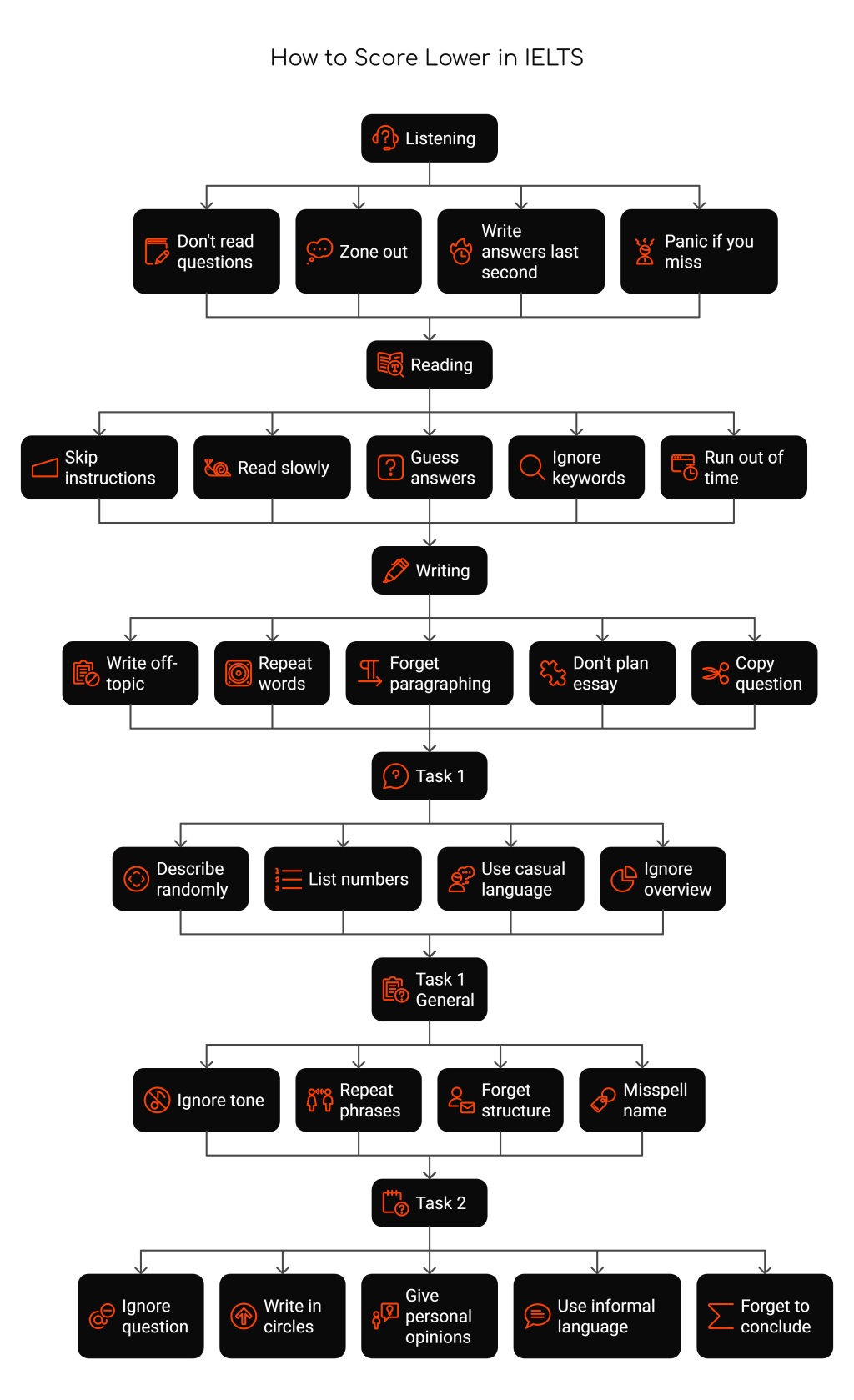
- Do not read the questions beforehand. Jump into the recording without preparation and hope to catch the answers by chance.
- Allow your mind to wander. Daydream about unrelated topics instead of focusing on the recording.
- Wait until the last second to write answers. Avoid taking notes and attempt to recall details at the last moment.
- Ignore logical predictions. Disregard grammatical cues and randomly guess words without considering their suitability.
- Panic if you miss an answer. Instead of moving forward, focus on what was missed and lose track of the subsequent content.
Reading: A Guessing Game
To struggle with IELTS Reading, follow these ineffective techniques:
- Ignore instructions. Misinterpret answer formats, such as writing “YES” instead of “TRUE.”
- Read every word slowly. Neglect skimming and scanning, ensuring you run out of time before completing all passages.
- Guess without referencing the text. Select answers arbitrarily without verifying information in the passage.
- Ignore keywords. Overlook the importance of matching question words with their counterparts in the passage.
- Spend too much time on one passage. Dedicate excessive time to a single section, leaving no time for the others.
Writing: How to Confuse the Examiner
To achieve a low Writing score, consider these ineffective approaches:
- Write off-topic. Address unrelated subjects instead of answering the given prompt.
- Repeat basic words excessively. Avoid advanced vocabulary and rely on simple adjectives.
- Neglect paragraphing. Present ideas in a single, unstructured block of text.
- Skip planning. Begin writing immediately without organizing ideas.
- Copy the question. Use large portions of the prompt instead of presenting original content.
Writing Task 1 (Academic): Misinterpreting Graphs
To ensure a poor response, try these methods:
- Describe figures randomly. List numbers without identifying trends or comparisons.
- Omit explanations. Provide statistics without context.
- Use informal language. Replace academic phrasing with casual expressions.
- Ignore the overview. Avoid summarizing key trends, which is essential for a strong response.
Writing Task 1 (General Training): How to Write an Ineffective Letter
To make your letter less effective, follow these steps:
- Disregard tone. Write a formal letter using informal language, or vice versa.
- Repeat phrases excessively. Overuse generic statements such as “I am writing to say…”
- Lack structure. Present ideas in a disorganized manner.
- Misspell the recipient’s name. Display carelessness in addressing the reader.
Writing Task 2: How to Write an Unclear Essay
To create a weak essay, consider these habits:
- Ignore the question. Discuss an unrelated topic instead of addressing the prompt.
- Repeat ideas. Restate the same concept in different words.
- Provide only personal opinions. Avoid supporting arguments with evidence or examples.
- Use informal language. Incorporate slang and casual expressions inappropriate for an academic essay.
- Omit a conclusion. End the essay abruptly without summarizing key points.
Speaking: One-Word Responses and Silence
To minimize your Speaking score, follow these ineffective practices:
- Give one-word answers. Respond with “Yes” or “No” instead of elaborating.
- Remain silent when unsure. Avoid attempting to answer unfamiliar questions.
- Memorize responses. Recite pre-learned answers instead of engaging naturally.
- Use only basic vocabulary. Refrain from employing varied and precise word choices.
- Panic after making a mistake. Stop speaking instead of correcting errors and continuing.
Final Tip: Want to Improve? Do the Opposite!
To achieve a high IELTS score, avoid these ineffective habits and adopt proper test-taking strategies. Practice consistently, remain calm, and prepare effectively.
Which of these IELTS mistakes have you made? Share your experience in the comments!
#IELTSGuidePhil #IELTS #HowToFailIELTS #IELTSWriting #IELTSSpeaking #IELTSListening #IELTSReading #IELTSPreparation
 IELTS Guide Phil
Leave a comment