
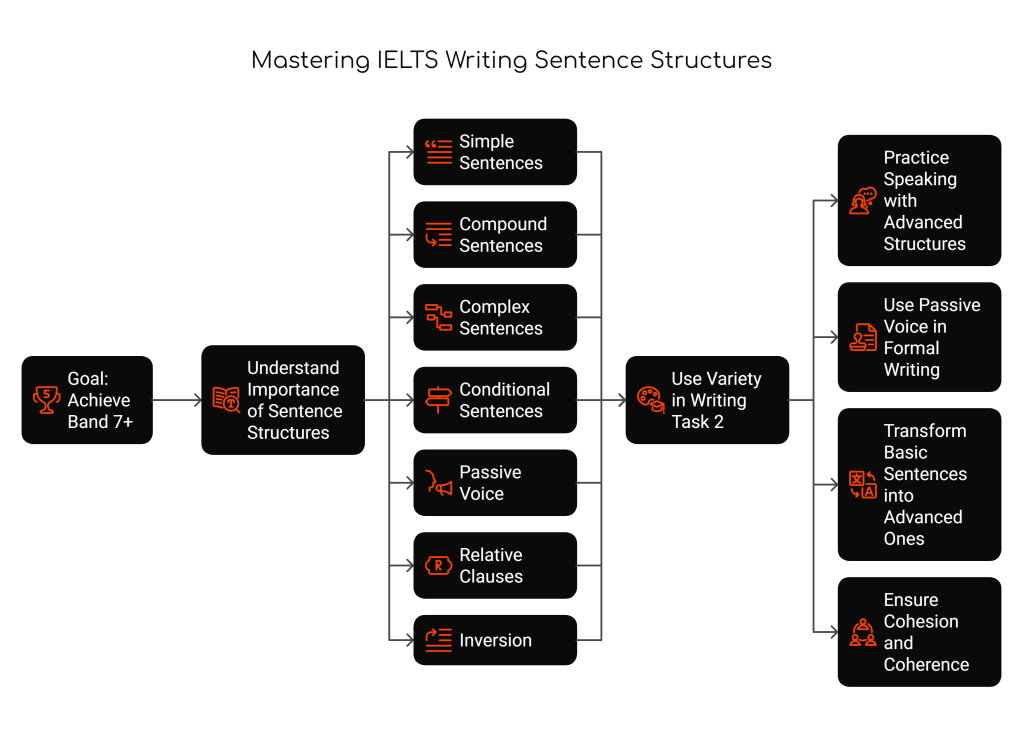
Achieving a Band 7+ in the IELTS Writing test requires more than just good ideas and vocabulary. One of the key criteria assessed by examiners is Grammatical Range & Accuracy, which accounts for 25% of your score. Many test-takers rely too heavily on simple sentences, making their writing sound basic and limiting their overall band score. To impress the examiner, you need to use a variety of sentence types effectively. Here’s how you can master sentence structure for IELTS success.
Essential Sentence Structures for a High IELTS Score
1. Simple Sentences
Simple sentences are clear and direct but should not be overused, as they can make your writing appear simplistic. Example: The internet is useful for research.
2. Compound Sentences
Compound sentences connect two related ideas using coordinating conjunctions (FANBOYS: for, and, nor, but, or, yet, so). Example: The internet is useful for research, but it can also be a source of misinformation.
3. Complex Sentences
These sentences combine an independent clause with a dependent clause using subordinating conjunctions (although, because, if, when, while, etc.). Example: Although the internet provides vast information, verifying sources is essential.
4. Conditional Sentences
Conditional sentences express real or hypothetical situations. Example (Second Conditional): If students managed their time well, they would perform better in exams.
5. Passive Voice
The passive voice focuses on the action rather than the doer, making it useful for formal writing. Example: Policies to reduce pollution have been implemented by the government.
6. Relative Clauses
Relative clauses provide additional information using who, which, that, whose, where. Example: Students who study consistently tend to score higher on exams.
7. Inversion
Inversion is an advanced structure used for emphasis in formal writing, often seen in Band 8-9 essays. Example: Rarely do people realize the importance of time management until they fail an exam.
Strategies to Improve Your Sentence Structure
1. Aim for Variety in Writing Task 2
- Use at least three to four complex sentences in your essay.
- Incorporate a mix of compound and complex sentences to maintain fluency.
- Include one inversion for an advanced touch.
2. Practice Speaking with Advanced Structures
- Instead of simple statements, expand your answers using conditionals and relative clauses.
- Example:
- Basic: I like traveling because it’s fun.
- Improved: I enjoy traveling, as it allows me to experience diverse cultures, which broadens my perspective.
3. Use Passive Voice in Formal Writing
- Especially useful in Writing Task 1 (Academic) and Writing Task 2.
- Example:
- Active: The government should reduce pollution.
- Passive: Measures to reduce pollution should be implemented by the government.
4. Transform Basic Sentences into Advanced Ones
- Take a simple idea and rewrite it using different structures.
- Example:
- Simple: Many people prefer online shopping.
- Complex: Many people prefer online shopping, as it offers convenience and a wider selection of products.
5. Focus on Cohesion and Coherence
- Use linking words to connect ideas smoothly (however, in contrast, moreover, consequently).
- Example:
- Disjointed: People like fast food. It is unhealthy.
- Improved: People enjoy fast food; however, it is often unhealthy due to its high calorie content.
Try This Exercise:
Rewrite this simple sentence using different structures: ➡️ Technology has changed education.
Share your answer in the comments and let’s practice together!
#IELTSGuidePhil #IELTSWriting #Band7Plus #IELTSTips #SentenceStructure #GrammaticalRange
 IELTS Guide Phil
Leave a comment