
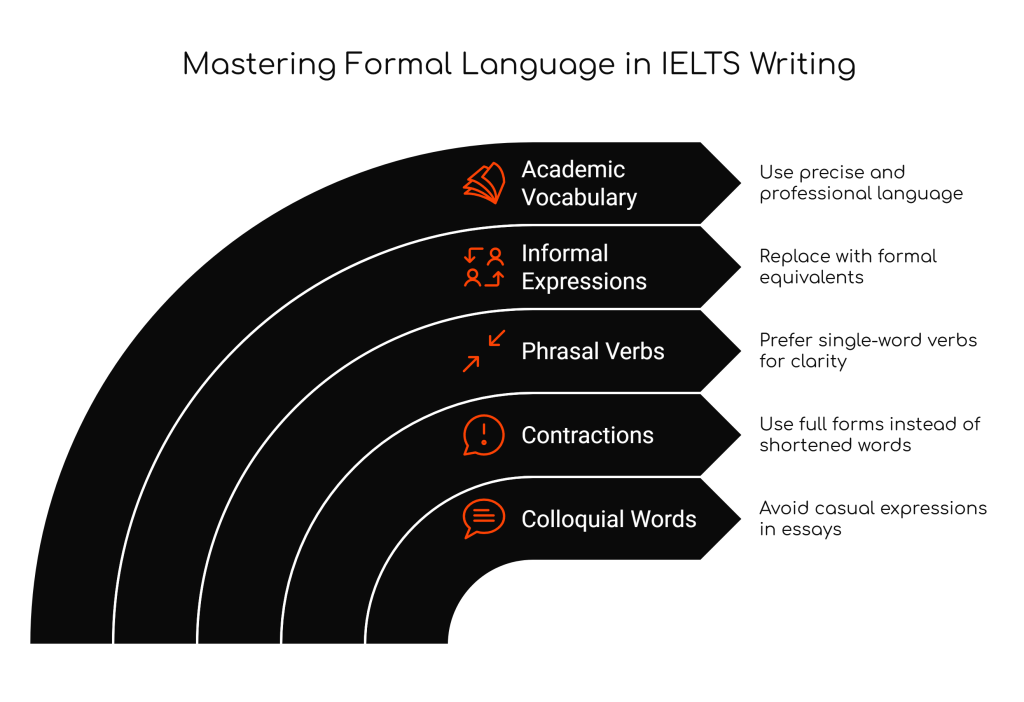
One of the most frequent mistakes IELTS candidates make in Writing Task 2 is the use of informal language. IELTS essays require formal, structured, and professional writing to achieve high scores in Coherence & Cohesion and Lexical Resource.
For those aiming for Band 7 or higher, it is crucial to learn how to eliminate informal expressions and refine writing style. This guide provides practical strategies to enhance formality in IELTS writing. You can watch this YouTube video explainer by IELTS Guide Phil.
Avoiding Informal Language in IELTS Essays
1. Colloquial Words and Expressions
Informal words and vague expressions should be replaced with precise vocabulary. Examples include:
- “stuff” → “materials/items”
- “a lot of” → “a significant amount of”
- “thing” → “aspect/element”
- “sort of” → “somewhat”
2. Contractions
Contractions are inappropriate for academic writing. Instead of:
- “can’t” → Use “cannot”
- “doesn’t” → Use “does not”
- “shouldn’t” → Use “should not”
3. Phrasal Verbs
Phrasal verbs tend to be conversational and should be replaced with academic alternatives:
- “put off” → “postpone”
- “bring up” → “raise”
- “find out” → “discover”
4. Bullet Points and Numbering
While acceptable in non-IELTS reports, bullet points should be avoided in essays, as they require continuous prose.
5. Direct Questions
Writing in a conversational tone by posing direct questions is discouraged. Instead of:
“What should we do about this issue?”
Use: “Possible solutions to this issue include…”
Exercise 1: Refining Informal Sentences
Below are examples of informal expressions with their formal equivalents:
Informal: There is a lot of social pressure to conform to a certain body shape.
Formal: There is a significant amount of social pressure to conform to a specific body shape.
Informal: He did well in isolating a new bacteria strain.
Formal: He succeeded in isolating a new bacterial strain.
Informal: These exercises can be done again a number of times.
Formal: These exercises can be repeated multiple times.
Practice Task
Rewrite the following sentence using formal language:
“The company is trying to get rid of old policies to make things better.”
Share your responses in the comments for feedback.
Exercise 2: Replacing Phrasal Verbs
Below are examples of how to replace informal phrasal verbs with their formal alternatives:
Informal: The company set up a new branch.
Formal: The company established a new branch.
Informal: They need to get rid of outdated policies.
Formal: They need to eliminate outdated policies.
Informal: The research team found out the cause of the disease.
Formal: The research team discovered the cause of the disease.
Practice Task
Rewrite the following sentence using formal language:
“The government has to come up with new policies to help the economy.”
Post your answer in the comments below.
Common Informal-to-Formal Word Replacements
Verbs
- “seem” → “appear”
- “help” → “assist”
- “stop” → “cease”
- “begin” → “commence”
- “get” → “obtain”
- “keep” → “preserve”
- “need” → “require”
- “empty” → “vacant”
Adverbs & Linking Words
- “in the end” → “finally”
- “at first” → “initially”
- “again and again” → “repeatedly”
- “so” → “therefore”
Nouns
- “chance” → “opportunity”
- “sweat” → “perspiration”
- “house” → “residence”
Adjectives
- “friendly” → “amiable”
- “cheap” → “inexpensive”
- “mad” → “insane”
- “clear” → “transparent”
Practice Task
Rewrite the following sentence using formal language:
“I wanna ask my boss for a chance to go up in the company.”
Share your response in the comments for evaluation and feedback.
Final Thoughts
Achieving a high band score in IELTS Writing Task 2 requires mastering formal language. Avoiding contractions, colloquial expressions, and phrasal verbs while employing precise academic vocabulary enhances writing professionalism.
Next Steps
- Incorporate formal writing into your IELTS practice.
- Submit your answers in the comments for feedback.
- Save this guide for quick revision.
By consistently refining your writing style, you will significantly improve your IELTS performance.
#IELTSGuidePhil #IELTS #IELTSWriting #AcademicWriting #IELTSPreparation #FormalLanguage #EnglishTips
 IELTS Guide Phil
Leave a comment