
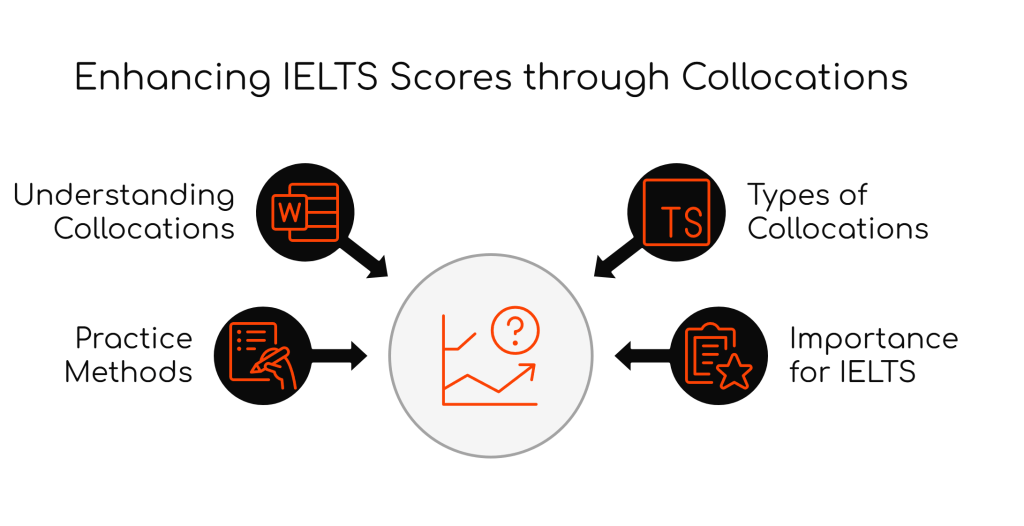
One of the most effective ways to enhance your English proficiency and achieve a higher band score in the IELTS exam is by mastering collocations. These are words that naturally go together in a phrase, making your speech and writing sound more fluent and natural. In the IELTS exam, strong knowledge of collocations can significantly improve your Lexical Resource score, which accounts for 25% of both the Writing and Speaking tests.
What Are Collocations?
Collocations are combinations of words that commonly appear together in English. Learning collocations instead of individual words helps you avoid unnatural phrasing and improves your ability to express ideas clearly.
Example:
Incorrect: I need to do my bed before leaving for school.
Correct: I need to make my bed before leaving for school.
In this example, the verb “make” is the correct word to use with “bed,” forming the collocation “make someone’s bed.”
Many learners struggle with collocations because direct translations from their native language do not always work. Instead of memorizing single words, it is more effective to learn words in meaningful chunks to use them naturally.
Why Are Collocations Important for IELTS?
- They enhance fluency and coherence – Examiners assess how naturally and accurately you use words together.
- They make your arguments more effective – Instead of saying “a big impact,” saying “a significant impact” sounds more academic and precise.
- They boost your Lexical Resource score – A strong grasp of collocations shows advanced vocabulary skills, essential for Band 7 or higher.
Types of Collocations & How to Use Them
1. Pay Attention to Different Word Forms
Many words have different collocations depending on whether they are used as a verb, noun, or adjective.
Example: “Influence”
Verb: My grandfather influenced me greatly when I was a child.
Collocation: influence someone greatly
Noun: My grandfather had a great influence on me when I was a child.
Collocation: have a great influence on someone
Key Point: The verb form does not need a preposition, while the noun form requires “on.” These small details make a big difference in IELTS Writing and Speaking.
2. Use More Complex Collocations to Show Advanced Vocabulary
Using more advanced structures can improve your Lexical Resource score.
Example: “Prefer”
Verb: I prefer traditional food over fast food.
Collocation: prefer something
Noun: I have a preference for traditional food.
Collocation: have a preference for something
Adjective: Traditional food is more preferable than fast food.
Collocation: find something preferable
Key Point: Using the noun or adjective form instead of the verb can make your writing and speaking sound more sophisticated.
3. Be Careful with Synonyms – Not All Have the Same Collocation
Not all synonyms follow the same grammatical structure, so it is essential to learn their correct usage.
Example: “Help” vs. “Assist”
Help: Parents can help their children (to) prepare for adult life.
Collocation: help someone (to) do something
Assist: Parents can assist their children in preparing for adult life.
Collocation: assist someone in doing something
Key Point: Even though “help” and “assist” have similar meanings, their collocations differ. “Help” is followed by an infinitive (to do), while “assist” is followed by “in” + -ing form.
4. Recognize Multiple Collocations for the Same Word
Some words can collocate with different verbs while keeping the same meaning.
Example: “Test”
- I have to take a test tomorrow.
- I have to sit a test tomorrow.
- I have to do a test tomorrow.
Key Point: All three sentences are correct, but “sit a test” is the least common. Using less common collocations can help you stand out in the IELTS exam. However, be careful with collocations like “set a test” or “make a test,” which refer to what a teacher does rather than a student.
How to Improve Your Use of Collocations
- Learn words in chunks – Study phrases instead of individual words.
- Read and listen to native English content – Pay attention to collocations in books, news articles, and TV shows.
- Use collocations in writing and speaking – Practice using advanced collocations in IELTS Writing Task 2 and Speaking Part 3.
- Keep a collocation notebook – Write down and review new collocations regularly.
Practice Exercise
Try using these collocations in a sentence:
- “have an impact on”
- “take something into account”
- “a significant increase in”
Example: The government should take environmental issues into account when making policies.
Which collocations do you use the most? Share your examples in the comments!
#IELTSGuidePhil #IELTSWriting #IELTSSpeaking #Collocations #IELTSTips #LearnVocabulary #LexicalResource
 IELTS Guide Phil
Leave a comment