
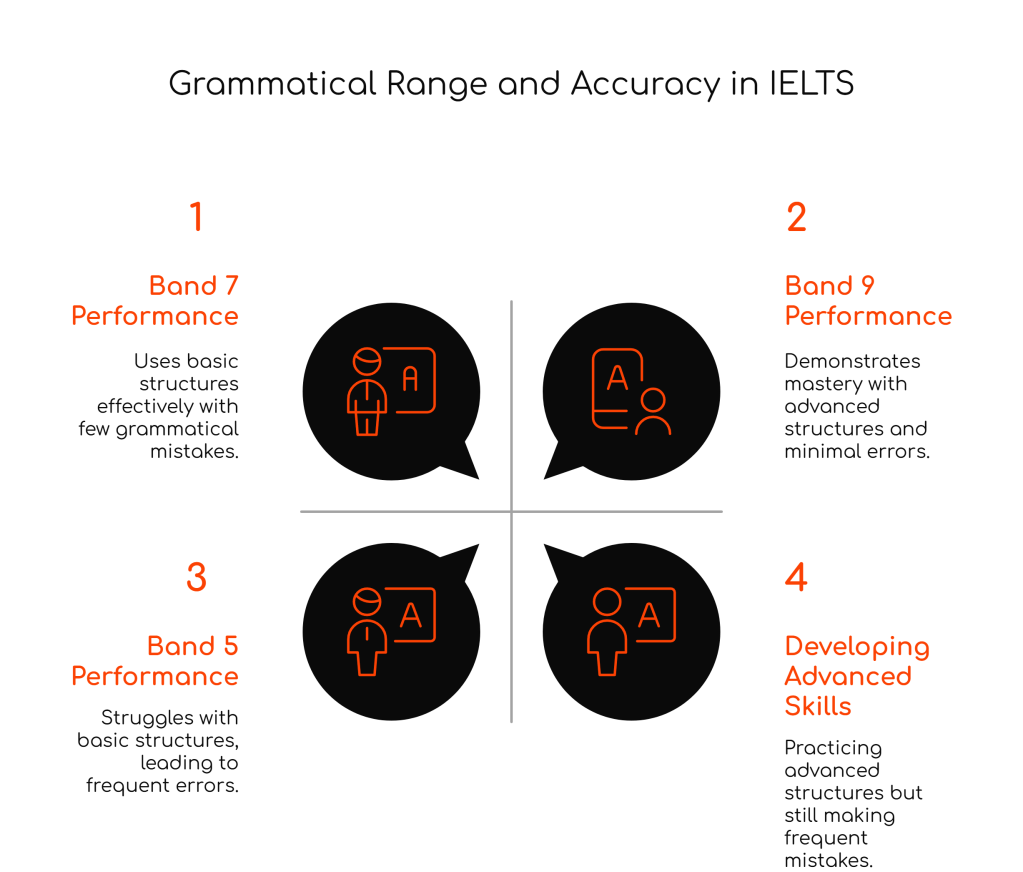
Grammatical Range and Accuracy (GRA) is a crucial criterion in both IELTS Writing and Speaking. To achieve a high band score, candidates must demonstrate a variety of sentence structures while minimizing grammar mistakes. This blog post will guide you through how IELTS examiners assess GRA, common grammar mistakes to avoid, and practice exercises to help you improve your score.
Understanding Grammatical Range & Accuracy
Grammatical Range refers to your ability to use different sentence structures, including simple, compound, and complex sentences.
Grammatical Accuracy assesses how correctly you use grammar structures with minimal errors.
IELTS Band Descriptors for GRA
Writing
- Band 9: Uses a wide range of structures with full accuracy and natural control.
- Band 7: Uses a variety of complex structures with some errors that do not affect meaning.
- Band 5: Uses basic sentence structures with frequent grammar mistakes that impact clarity.
Speaking
- Band 9: Produces error-free sentences with natural fluency.
- Band 7: Uses complex structures but makes some grammatical mistakes.
- Band 5: Relies on simple sentences with noticeable errors.
How to Improve Grammatical Range & Accuracy
1. Use a Variety of Sentence Structures
To impress the examiner, mix different sentence types:
- Simple Sentences → The study highlights an increase in global temperatures.
- Compound Sentences → The study highlights an increase in global temperatures, but the causes remain unclear.
- Complex Sentences → Although global temperatures are rising, experts disagree on the primary cause.
- Passive Voice → An increase in global temperatures has been observed by scientists.
Practice Tip: Take a simple sentence and rewrite it using three different sentence structures.
2. Avoid Common Grammar Mistakes
- Incorrect: The number of students are increasing. Correct: The number of students is increasing. (Subject-verb agreement)
- Incorrect: Many people think that technology is useful, they also believe it is harmful. Correct: Many people think that technology is useful, but they also believe it is harmful. (Comma splice error)
- Incorrect: If I will study hard, I will pass. Correct: If I study hard, I will pass. (Conditional mistake)
Practice Tip: Write five sentences using different grammar structures and check for common errors.
3. Incorporate Advanced Grammar Features
- Relative Clauses → Students who study regularly perform better.
- Conditional Sentences → If I had studied harder, I would have passed.
- Inversions → Never have I seen such dedication.
Practice Tip: Try rewriting a sentence using a relative clause, inversion, and conditional.
4. Master Articles, Prepositions & Tenses
- Articles: A teacher, an apple, the internet
- Prepositions: Interested in, good at, similar to
- Tenses: I have lived here for five years (Present Perfect)
Practice Tip: Find an IELTS essay and highlight all articles, prepositions, and tenses to analyze their usage.
IELTS Practice Exercises
Exercise 1: Correct the Grammar Mistakes
Identify and correct the errors:
- The informations are important for students.
- She didn’t used to like coffee.
- The children was playing outside.
- He want to go abroad for studies.
- There is many reasons for this problem.
Exercise 2: Rewrite the Sentences Using Complex Structures
Improve these simple sentences:
- People say that crime is increasing.
- Technology makes life easier.
- More people are working from home.
- Some cities are very polluted.
- Education is important.
IELTS Speaking Exercises
- Task 1: Describe your favorite book using a variety of sentence structures.
- Task 2: Talk about a time you made a mistake and what you learned from it.
- Task 3: Discuss whether technology is improving or harming human interaction.
Challenge: Record yourself speaking and analyze your grammar. Did you use a variety of tenses? Any mistakes?
Answers
Exercise 1: Corrected Sentences
- The information is important for students. (Uncountable noun)
- She didn’t use to like coffee. (Past simple structure)
- The children were playing outside. (Subject-verb agreement)
- He wants to go abroad for studies. (Third-person singular agreement)
- There are many reasons for this problem. (Plural agreement)
Exercise 2: Rewritten Sentences
- Crime, which is becoming a major issue, is said to be increasing. (Relative clause)
- Life is made easier by technology. (Passive voice)
- As more people work from home, the traditional office environment is changing. (Complex sentence)
- Some cities are so polluted that air quality is dangerously low. (Cause and effect structure)
- If education were free for everyone, society would benefit greatly. (Conditional sentence)
Final Tips for IELTS Success
- Read Academic Texts: Notice how grammar is used in articles, research papers, and essays.
- Write and Self-Check: Use grammar-checking tools to analyze your mistakes.
- Record Yourself Speaking: Identify grammatical errors and try again.
- Use IELTS-Specific Resources: Try online quizzes and practice tests to refine your skills.
Want more IELTS tips? Leave a comment below!
#IELTS #IELTSGuidePhil #IELTSWriting #GrammaticalRange #GrammarTips #IELTSSpeaking #WritingSkills #IELTSPreparation #StudyEnglish
 IELTS Guide Phil
Leave a comment