
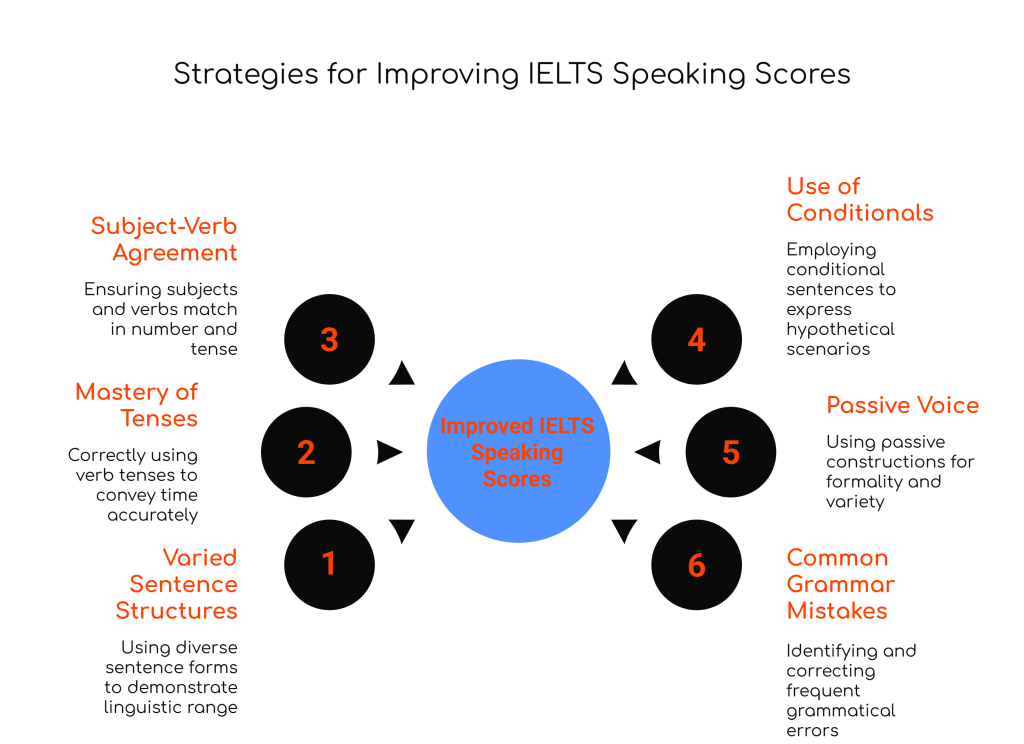
Grammar plays a crucial role in IELTS Speaking, as it directly impacts your Grammatical Range & Accuracy (GRA) score. To achieve a high band score, candidates must use a variety of sentence structures correctly and naturally. In this guide, we will explore essential grammar concepts, common mistakes, and practical exercises to help you speak fluently and accurately.
1. Using a Variety of Sentence Structures
A high band score requires diversity in sentence structures. Instead of relying solely on simple sentences, aim to mix different types.
✔ Simple Sentence: I enjoy reading books. ✔ Compound Sentence: I enjoy reading books, and I also like watching movies. ✔ Complex Sentence: Although I enjoy reading books, I sometimes prefer movies.
Tip: IELTS examiners look for complexity. Using a combination of sentence types makes your speech more natural and engaging.
2. Mastering Tenses & Verb Forms
Using the right tense based on context is key to maintaining grammatical accuracy.
Common Tenses in IELTS Speaking
- Past Simple (Completed actions): I traveled to Japan last year.
- Present Perfect (Life experiences): I have visited many countries.
- Future (Plans and intentions): I will start a new job next year.
- Present Continuous (Ongoing actions): Right now, I am learning French.
Common Mistake: Incorrect: I have gone to Japan last year. Correct: I went to Japan last year.
Tip: Avoid tense inconsistencies and ensure your verb tenses match the time reference.
3. Subject-Verb Agreement
Errors in subject-verb agreement are common among IELTS candidates. Always ensure the verb matches the subject in number and tense.
Incorrect: She go to work every day. → Correct: She goes to work every day. Incorrect: People enjoys traveling. → Correct: People enjoy traveling.
Tip: Remember that singular subjects take singular verbs (he goes, she works) while plural subjects take plural verbs (they go, people work).
4. Using Conditionals to Sound More Advanced
Conditional sentences add depth to your speech and demonstrate a higher level of grammatical accuracy.
Types of Conditionals
- Zero Conditional (Facts): If you heat water, it boils.
- First Conditional (Real Future Situations): If I have time, I will help you.
- Second Conditional (Hypothetical Present/Future): If I had a million dollars, I would travel the world.
- Third Conditional (Past Hypotheticals): If I had studied harder, I would have passed.
Common Mistake: Incorrect: If I will see her, I tell her. Correct: If I see her, I will tell her.
Tip: The if-clause never takes ‘will’ in conditional sentences.
5. Using Passive Voice for Formality
The passive voice makes your speech sound more sophisticated and academic, which can boost your score.
- Active: People speak English in many countries.
- Passive: English is spoken in many countries.
Tip: Use passive structures when you want to emphasize the action rather than the subject.
6. Common Grammar Mistakes & Corrections
Incorrect: She go to university every day. → Correct: She goes to university every day. Incorrect: He told that he is busy. → Correct: He said that he is busy. Incorrect: I have visited Paris last year. → Correct: I visited Paris last year.
Tip: Reviewing common errors can help you avoid them in your IELTS Speaking test.
7. IELTS Speaking Practice Exercises
Exercise 1: Correct the Grammar Mistakes
- She go to university every day.
- If I will see her, I tell her.
- He said me that he was busy.
- I have visited Paris last year.
- He like playing football.
Exercise 2: Make the Sentences More Advanced
- The weather is good today. (Use a relative clause)
- People speak many languages in India. (Use passive voice)
- If I had money, I would buy a house. (Use a different conditional)
- He finished his homework. He went out. (Use a complex sentence)
- She is my teacher. She teaches English. (Use a relative clause)
Tip: Practice speaking these corrected sentences aloud to reinforce grammar accuracy in natural speech.
Final Tips for IELTS Speaking Success
- Record Yourself Speaking: Listen for grammar mistakes and correct them.
- Use Sentence Structures Naturally: Do not force complex structures—use them when appropriate.
- Practice with a Partner: Get feedback to improve accuracy and fluency.
By mastering these grammatical structures, you will be well on your way to achieving a high band score in IELTS Speaking.
Have any grammar questions? Leave a comment below.
#IELTSGuidePhil #IELTS #IELTSSpeaking #GrammarForIELTS #StudyEnglish #EnglishSpeakingSkills #IELTSPreparation
 IELTS Guide Phil
Leave a comment