
The IELTS Listening test is designed to assess your ability to understand spoken English in various real-life and academic contexts. Many test-takers find it challenging due to unfamiliar vocabulary, different accents, and fast-paced speech. However, by recognizing common words and phrases frequently used in the test, you can improve your comprehension and response accuracy. This guide breaks down essential vocabulary by section, providing examples to help you become more confident in tackling the listening component.
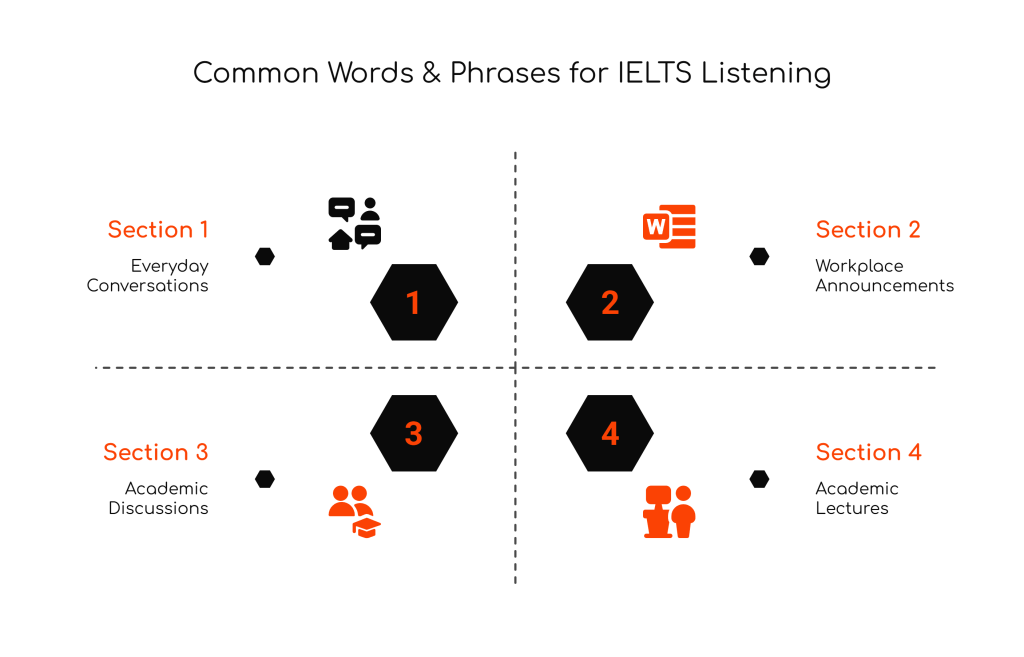
Section 1: Everyday Conversations
This section involves routine conversations, such as booking appointments, making inquiries, and providing personal details. The language used is informal and straightforward, but missing key details can cost you points.
Common Words & Phrases:
- Full name, date of birth, address, postcode, phone number
- Per person, per night, including tax, deposit, discount
- Timetable, departure, arrival, platform, bus stop, return ticket
- Appointment, reservation, confirmation, cancellation, refund
Example Sentences:
- “Could you spell your surname for me, please?”
- “The next train departs at 3:45 PM from platform 6.”
- “Is breakfast included in the price of the room?”
Listening Tip: Pay attention to numbers, dates, and names, as they are common answers in this section. Also, be mindful of spelling and variations in pronunciation.
Section 2: Workplace and Public Announcements
This section often features workplace discussions, company briefings, or public service announcements, requiring you to grasp important details regarding events, rules, and instructions.
Common Words & Phrases:
- Main entrance, reception, conference room, parking area
- Safety regulations, prohibited, required, recommended
- Workshop, seminar, exhibition, registration, deadline
- Supervisor, department, colleagues, responsibilities, training
Example Sentences:
- “The safety briefing will take place in the conference hall on the second floor.”
- “All employees must wear a helmet at all times.”
- “The registration deadline for the workshop is next Friday at noon.”
Listening Tip: Listen carefully for instructions and deadlines, as these are frequently tested. Be aware of words that indicate obligation (e.g., “must,” “required”) versus suggestions (e.g., “recommended,” “optional”).
Section 3: Academic Discussions
This section typically involves student-tutor discussions, group projects, or academic consultations. The vocabulary is more specialized, covering topics related to coursework and research.
Common Words & Phrases:
- Coursework, dissertation, thesis, deadline, plagiarism
- Journal articles, bibliography, reference, peer-reviewed
- Brainstorming, feedback, draft, revision
- Presentation, outline, citation, proposal, submission
Example Sentences:
- “The deadline for submitting the dissertation is April 30th.”
- “We need to find at least three peer-reviewed journal articles for our research.”
- “Can you give me feedback on my essay draft before I submit it?”
Listening Tip: Take note of academic terms and their contexts. Synonyms are often used in the questions and recordings, so be ready to identify reworded phrases.
Section 4: Academic Lectures and Presentations
This section involves formal lectures on a variety of subjects. The vocabulary is more technical and structured, with logical transitions guiding the discussion.
Common Words & Phrases:
- Hypothesis, findings, methodology, experiment, case study
- First of all, moving on to, in contrast, to summarize
- Ecosystem, phenomenon, sustainable, correlation, variables
- Theory, framework, significance, interpretation, implications
Example Sentences:
- “The research findings indicate a strong correlation between diet and cognitive performance.”
- “First of all, let’s define the key terms before we move on to the case study.”
- “The results suggest a significant impact of climate change on marine biodiversity.”
Listening Tip: Academic lectures follow a structured pattern. Pay close attention to signal words that indicate explanations, comparisons, and conclusions.
Final Practice Tip:
When practicing for the IELTS Listening test, actively listen to recordings that reflect real-life scenarios, such as news reports, podcasts, and academic lectures. Focus on identifying key words, synonyms, and context clues. By familiarizing yourself with common vocabulary, you can anticipate answers more effectively and improve your overall comprehension.
Which section do you find the most challenging? Share your experiences in the comments below!
#IELTSListening #IELTSGuidePhil #IELTS #IELTSPreparation #IELTSGuide #StudyAbroad #EnglishProficiency #IELTSTips #IELTSExam #TestPreparation #IELTSAcademic #IELTSGeneralTraining #LanguageTesting
 IELTS Guide Phil
Leave a comment