
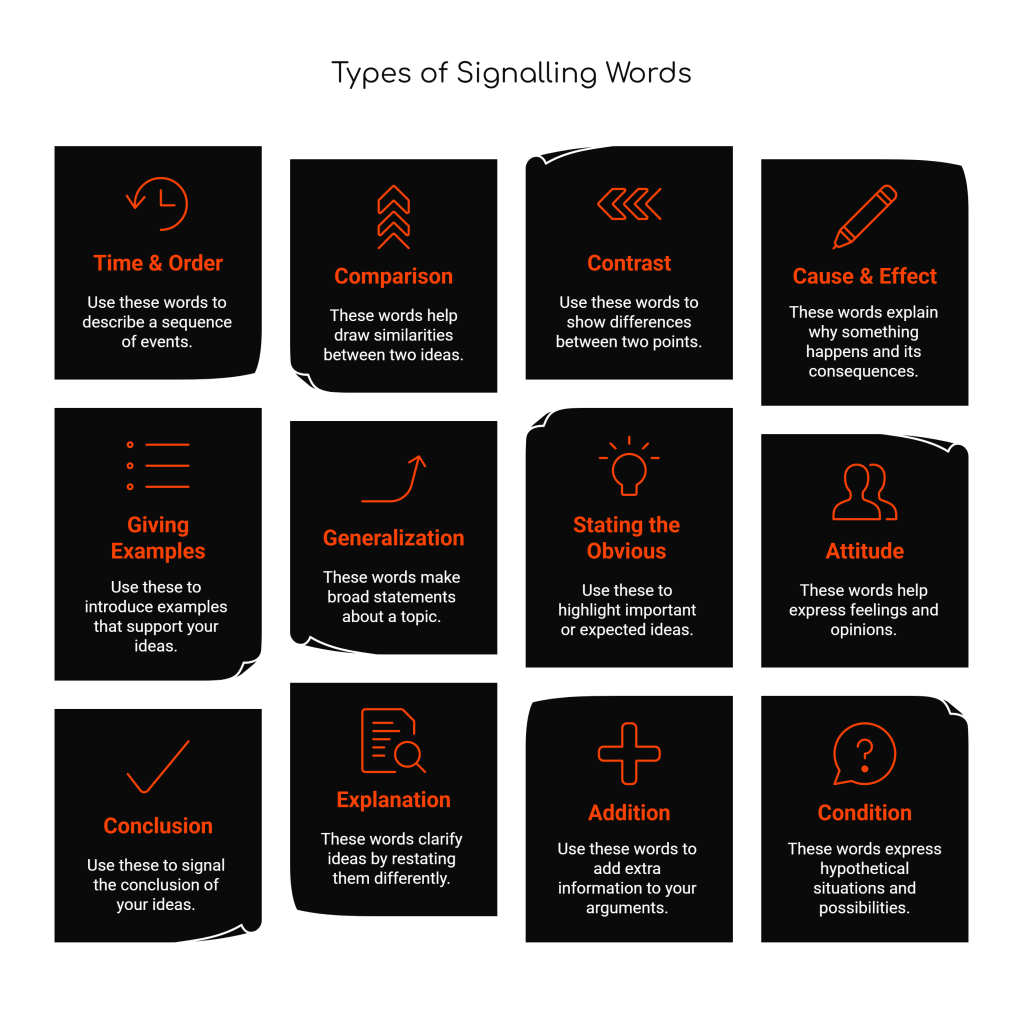
Have you ever read a paragraph that felt smooth and easy to understand? Good writing isn’t just about presenting ideas—it’s about connecting them logically. This is where signalling words play a crucial role. These powerful words and phrases help guide your reader through your arguments, making your writing clear, organized, and persuasive. You can watch this YouTube video explainer by IELTS Guide Phil.
Let’s explore different types of signalling words, why they matter, and how to use them effectively.
1. Time & Order: Keeping Events Organized
Use these words when describing a sequence of events or steps.
Examples:
- At first, I found IELTS writing difficult, but practice made it easier.
- Finally, she achieved her desired band score!
- To begin with, let’s discuss the structure of a good essay.
When to use them: To present events in a logical order.
2. Comparison: Showing Similar Ideas
These words help you draw similarities between two ideas.
Examples:
- IELTS Writing Task 2 requires strong arguments. Similarly, Task 1 needs clarity.
- The IELTS Reading test is time-pressured. In the same way, the Listening test requires quick thinking.
When to use them: To highlight similarities between two points.
3. Contrast: Highlighting Opposing Ideas
Want to show differences between two points? These words will help!
Examples:
- The Academic IELTS is for university admissions. On the other hand, the General Training IELTS is for work or migration.
- Some students study for hours. However, others prefer shorter sessions.
- Despite studying hard, he struggled with Task 1.
When to use them: To compare opposite ideas.
4. Cause & Effect: Explaining Reasons & Results
Use these when explaining why something happens and its consequences.
Examples:
- She practiced daily. As a result, she improved her score.
- He didn’t manage his time well. Consequently, he ran out of time in the exam.
- Because of this, he had to retake the test.
When to use them: To link reasons to outcomes.
5. Giving Examples: Supporting Your Ideas
Examples make arguments stronger! Use these to introduce them.
Examples:
- Many students struggle with writing. For example, Task 2 requires strong argumentation.
- There are many ways to practice listening, such as watching English movies.
- Writing has many challenges. Thus, practicing daily is essential.
When to use them: To provide examples that support your point.
6. Generalization: Talking About Trends
Use these when making broad statements about a topic.
Examples:
- As a rule, reading daily improves vocabulary.
- Generally, students find Writing Task 2 more challenging than Task 1.
- On the whole, IELTS candidates aim for Band 7 or higher.
When to use them: To make a general statement.
7. Stating the Obvious: Emphasizing Key Points
Sometimes, we need to highlight important or expected ideas.
Examples:
- Clearly, time management is crucial in the IELTS test.
- Obviously, vocabulary plays a huge role in your score.
- Of course, regular practice leads to improvement.
When to use them: To emphasize well-known ideas.
8. Attitude: Showing Feelings & Opinions
Expressing opinions? These words help set the tone!
Examples:
- Fortunately, IELTS is accepted worldwide.
- Admittedly, Task 1 can be tricky at first.
- Unfortunately, many students don’t practice speaking enough.
When to use them: To express an opinion or feeling.
9. Conclusion: Wrapping Up Ideas
When ending a paragraph, signal the conclusion clearly.
Examples:
- To sum up, practice and strategy lead to success.
- In conclusion, preparation is the key to IELTS success.
- Overall, improving writing takes time and effort.
When to use them: To summarize a point.
10. Explanation: Clarifying Ideas
Need to restate something in a different way? Use these words!
Examples:
- Writing is important. In other words, strong writing skills can boost your score.
- The exam has four sections, that is to say, listening, reading, writing, and speaking.
When to use them: To clarify an idea.
11. Addition: Expanding Ideas
Use these words to add extra information.
Examples:
- The Writing test is important. Moreover, it affects your overall band score.
- Time management is key. Besides, it helps reduce stress.
When to use them: To add more points to an argument.
12. Condition: Expressing Possibilities
Use these when talking about hypothetical situations.
Examples:
- If you study daily, you will improve. In that case, you’ll feel more confident.
- Then, you can focus on test-taking strategies.
When to use them: To discuss conditions or possible outcomes.
Final Thoughts
Signalling words make writing clear, structured, and easy to follow. Mastering them will significantly boost your IELTS Writing score.
Which signalling words do you use the most? Share your thoughts!
#IELTSGuidePhil #IELTSWriting #Signalling #IELTSTips #LinkingWords #Cohesion
 IELTS Guide Phil
Leave a comment