
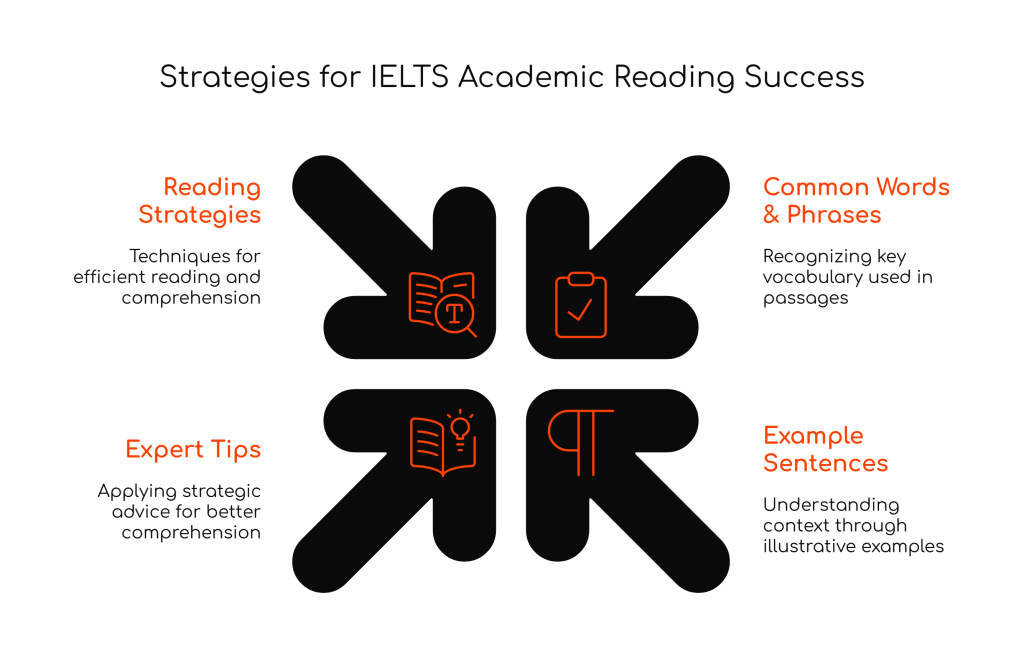
The IELTS Academic Reading section can be challenging, filled with complex vocabulary, tricky paraphrasing, and difficult questions. However, the key to success lies in recognizing common words and phrases used in different passage types. This guide will break them down with examples and expert strategies to help you boost your score.
Passage 1: Factual & Descriptive Texts (Science, History, Technology)
These passages typically provide informative articles about discoveries, inventions, historical events, or scientific concepts.
Common Words & Phrases:
- Scientific & Research Terms: experiment, hypothesis, observation, findings, survey, variables, analysis, correlation
- Discovery & Invention: innovation, breakthrough, ancient, evolution, adaptation, revolution, mechanism
- Trends & Changes: decline, increase, fluctuation, rapid growth, gradual improvement, impact, consequences
Example Sentences:
- “The experiment’s findings indicated a strong correlation between air pollution and respiratory diseases.”
- “The industrial revolution led to a significant increase in factory-based jobs.”
- “The invention of the printing press was a major breakthrough in communication history.”
Expert Tip:
Look for cause-and-effect relationships in these passages. Phrases like “Because of X, Y happened” or “This led to…” often signal answers in multiple-choice and summary completion questions.
Passage 2: Argumentative & Opinion-Based Articles (Social Issues, Business, Education)
These passages present different viewpoints on social, business, or educational topics.
Common Words & Phrases:
- Opinions & Perspectives: debate, perspective, proponents, critics argue, advocates suggest, researchers claim, some people believe, others oppose
- Controversial & Ethical Topics: inequality, discrimination, bias, ethical concerns, fairness, justice, societal impact
- Trends & Global Issues: modernization, globalization, transformation, urbanization, digital revolution, economic shift
Example Sentences:
- “Many advocates suggest that remote work increases productivity, while critics argue it reduces teamwork.”
- “The modernization of education has led to a shift towards online learning.”
- “Proponents of AI believe it will improve efficiency, but opponents worry about job losses.”
Expert Tip:
Pay attention to contrast and agreement phrases such as:
- Opposing views: However, although, in contrast, on the other hand
- Agreement: Similarly, likewise, in the same way
- References to sources: According to, researchers claim, studies show
These clues help identify the author’s opinion and locate answers for True/False/Not Given and Matching Information questions.
Passage 3: Scientific & Academic Discussions (Medicine, Environment, Psychology)
These passages involve complex, research-based discussions with advanced vocabulary.
Common Words & Phrases:
- Scientific & Analytical Terms: theory, assumption, hypothesis, analysis, findings, statistical evidence, methodology, experiment
- Psychology & Human Behavior: cognitive, neurological, psychological, perception, stimuli, mental processes, reasoning
- Environment & Sustainability: conservation, renewable energy, emissions, deforestation, ecosystem, climate change, carbon footprint
Example Sentences:
- “The theory suggests that children’s cognitive development is influenced by early social interactions.”
- “Scientists advocate for the use of renewable energy to reduce carbon emissions.”
- “The study analyzed how different stimuli affect neurological responses.”
Expert Tip:
Academic texts often use synonyms instead of repeating words. For example:
- “Ecological balance” → “biodiversity”
- “Reduction of fossil fuels” → “decreasing reliance on non-renewable energy”
Improving your paraphrasing skills will enhance your ability to locate key information in the passage.
Key IELTS Reading Strategies You MUST Know
1. Skim & Scan Efficiently
Do not read every word—skim for main ideas and scan for keywords. Focus on:
- Headings & subheadings → main topic
- First & last sentence of each paragraph → key points
- Dates, names, percentages → often linked to questions
2. Identify Synonyms & Paraphrasing
IELTS questions rarely use the same words as the passage. Practice recognizing:
- Increase → Growth, Surge, Rise
- Effect → Impact, Consequence, Outcome
- Support → Advocate, Recommend, Endorse
3. Master True/False/Not Given Questions
- TRUE → The statement is directly in the text.
- FALSE → The text gives opposite information.
- NOT GIVEN → There’s no information about it at all.
Tip: If you cannot find a direct contradiction, it’s probably Not Given.
4. Manage Your Time Wisely
- 60 minutes for 3 passages → Aim for 20 minutes per passage.
- Answer the easiest questions first (e.g., Matching Headings, Fill in the Blanks).
- Save the hardest questions for last (e.g., True/False/Not Given, Yes/No/Not Given).
Final Thoughts
Understanding key words, phrases, and expert strategies can significantly improve your IELTS Academic Reading performance. Consistent practice with skimming, scanning, and paraphrasing will help you recognize patterns in question types and locate answers quickly.
Which IELTS Reading passage type do you find most challenging? Share your thoughts in the comments!
Save this guide and review these tips before your test! If you found this helpful, share it with a friend preparing for IELTS.
#IELTSReading #IELTSGuidePhil #IELTS #IELTSPreparation #IELTSGuide #StudyAbroad #EnglishProficiency #IELTSTips #IELTSExam #TestPreparation #IELTSAcademic #IELTSGeneralTraining #LanguageTesting
 IELTS Guide Phil
Leave a comment