
Preparing for the IELTS General Training Reading test can feel overwhelming, but don’t worry—you’re not alone! With the right strategies, a strong vocabulary, and an understanding of common question patterns, you can boost your reading skills and answer questions faster and more accurately. In this guide, we’ll break down each section of the test, highlight essential words and phrases, and provide expert strategies to help you succeed.
Understanding the IELTS General Training Reading Test
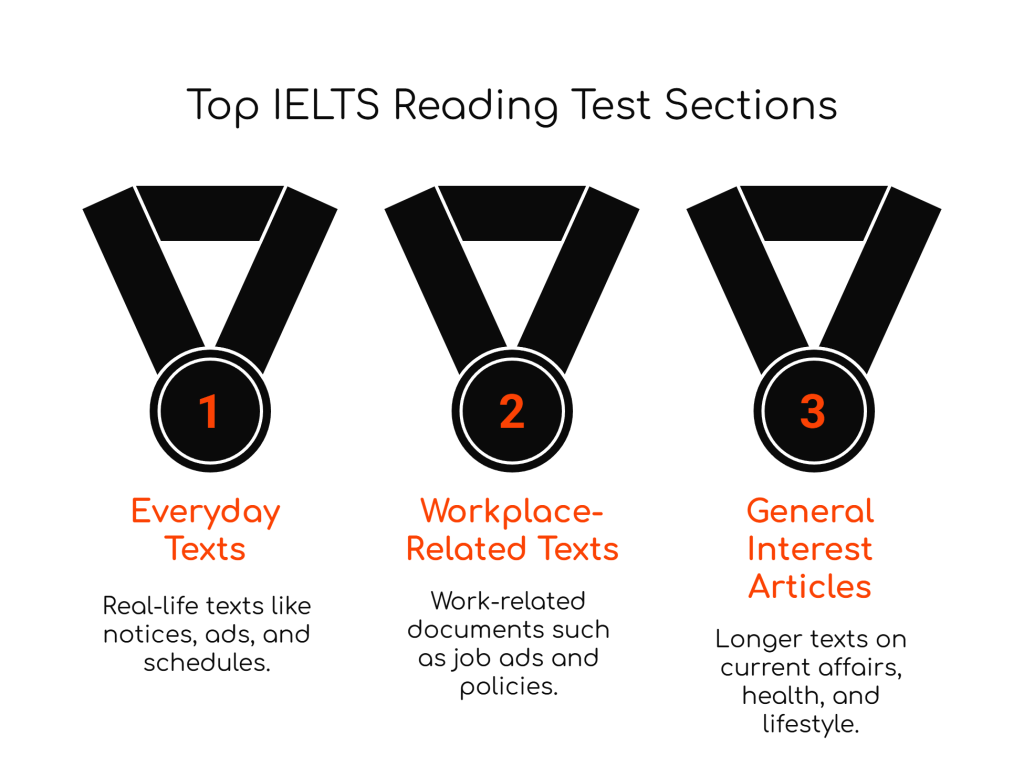
The General Training Reading test consists of three sections, each designed to assess your ability to read and comprehend different types of real-world texts. Let’s explore what to expect and how to tackle each section effectively.
Section 1: Everyday Texts (Notices, Ads, Schedules, Letters)
This section features real-life texts that you might encounter in daily situations, such as public notices, advertisements, schedules, and personal letters.
What to Expect?
- Reading a bus schedule and finding the correct departure time.
- Understanding a gym membership policy and its cancellation rules.
- Deciphering an advertisement for a special offer in a store.
Common Words & Phrases:
- Apply, available, register, contact, deadline, limited offer, clearance sale, penalty, prohibited, safety regulations.
Example Sentences:
- “All applications must be submitted before the deadline to be considered.”
- “This offer is valid until June 30.”
- “Parking in this area without a permit is prohibited and may result in a fine.”
Pro Tip: Scan for numbers, dates, and action words (e.g., must, required, apply, deadline). These details often contain direct answers to questions!
Section 2: Workplace-Related Texts (Job Ads, Company Policies, Training Manuals)
This section assesses your ability to understand work-related documents such as job descriptions, company policies, safety rules, and training materials.
What to Expect?
- A job advertisement listing specific skills and experience requirements.
- A company safety manual outlining workplace regulations.
- A staff memo about upcoming training sessions.
Common Words & Phrases:
- Vacancy, full-time, part-time, temporary, experience required, responsibilities, qualifications, compliance, training session, employee handbook.
Example Sentences:
- “Candidates must have at least two years of experience in customer service.”
- “All employees are required to comply with company regulations regarding workplace safety.”
- “The training workshop will be held on Monday at 10 AM.”
Pro Tip: Pay close attention to modal verbs like must, should, may, required—they indicate obligation levels and are crucial for answering questions correctly!
Section 3: General Interest Articles (Magazines, Newspapers, Reports)
The final section includes longer, more complex texts, similar to those found in magazines, newspapers, or reports. These passages discuss current affairs, health, lifestyle, travel, and technology.
What to Expect?
- A magazine article about a new health trend.
- A report on climate change and its effects.
- A travel guide highlighting the best tourist destinations.
Common Words & Phrases:
- Research suggests, study indicates, benefits, impact, advantages, drawbacks, environmental issues, cultural impact, psychological effects.
Example Sentences:
- “Recent research indicates that regular exercise can improve mental health.”
- “The author claims that urbanization has significantly affected local wildlife.”
- “This article explores the advantages and disadvantages of remote work.”
Pro Tip: The IELTS test frequently uses synonyms and paraphrasing. If the question says benefits, the passage may say advantages. Recognizing these substitutions will help you locate answers faster!
Bonus: 4 Game-Changing IELTS Reading Strategies
1. Skim & Scan Like a Pro!
- Don’t read every word—skim for the main idea and scan for keywords to locate answers quickly.
- Focus on headings, bold words, numbers, and dates.
2. Master Synonyms & Paraphrasing!
IELTS questions rarely use the exact words from the passage, so be prepared for rewording.
- Discount → Price reduction, special offer
- Mandatory → Required, compulsory
- Job vacancy → Employment opportunity, open position
3. Conquer True/False/Not Given Questions!
- TRUE → The statement is exactly in the passage.
- FALSE → The text contradicts the statement.
- NOT GIVEN → The passage does NOT mention the information at all.
Pro Tip: If you can’t find any proof, it’s probably Not Given!
4. Manage Your Time Wisely
You have 60 minutes for three sections. Here’s how to divide your time effectively:
- 15 minutes for Section 1 (Straightforward texts)
- 15 minutes for Section 2 (Work-related documents)
- 30 minutes for Section 3 (The longest and most complex passage)
Pro Tip: Answer the easiest questions first to build confidence and save time!
Final Words
The IELTS General Training Reading test is all about practice! The more familiar you become with common words, phrases, and question patterns, the more efficient and accurate you’ll be on test day.
Want to improve faster?
- Read newspapers, advertisements, workplace notices, and travel brochures regularly.
- Practice IELTS-style questions under timed conditions.
- Learn to recognize synonyms and paraphrasing—it’s the key to success!
Save this guide and share it with fellow IELTS test-takers! Stay tuned for more expert IELTS tips!
#IELTSGuidePhil #IELTS #IELTSGeneralTraining #IELTSReading #IELTSPreparation #EnglishLearning #StudyAbroad #IELTSTips #LanguageLearning
 IELTS Guide Phil
Leave a comment