
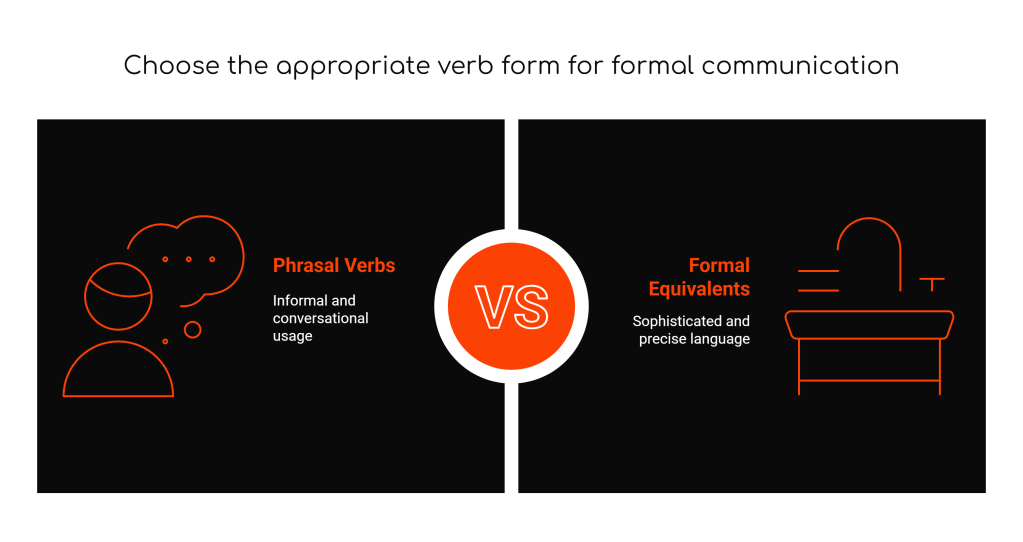
Phrasal verbs are widely used in everyday English, but in academic writing and professional communication, more formal alternatives are preferred. Mastering these expressions will not only boost your IELTS Writing and Speaking scores but also refine your academic essays and workplace communication.
This guide provides 100 common phrasal verbs with their formal equivalents, along with examples to help you use them effectively.
A-B: Enhancing Clarity in Writing
✅ Add up ➔ Make sense
- His explanation didn’t add up. ➔ His explanation didn’t make sense.
✅ Back up ➔ Support
- Can you back up your argument with evidence? ➔ Can you support your argument with evidence?
✅ Blow up ➔ Explode
- The gas tank blew up due to high pressure. ➔ The gas tank exploded due to high pressure.
✅ Break down ➔ Stop functioning
- My car broke down on the highway. ➔ My car stopped functioning on the highway.
✅ Bring about ➔ Cause to happen
- The new policy brought about significant changes. ➔ The new policy caused significant changes to happen.
✅ Bring up ➔ Mention a topic / Raise a child
- She brought up an important issue in the meeting. ➔ She mentioned an important issue in the meeting.
- They brought up their children well. ➔ They raised their children well.
✅ Bump into ➔ Meet unexpectedly
- I bumped into my old teacher yesterday. ➔ I encountered my former teacher unexpectedly.
C-D: Refining Formal Speech
✅ Call off ➔ Cancel
- The event was called off due to bad weather. ➔ The event was canceled due to bad weather.
✅ Carry on ➔ Continue
- Despite the challenges, she carried on with her work. ➔ Despite the challenges, she continued with her work.
✅ Cut down on ➔ Reduce
- He needs to cut down on sugar consumption. ➔ He needs to reduce his sugar consumption.
✅ Cut off ➔ Stop or disconnect
- The electricity was cut off during the storm. ➔ The electricity was disconnected during the storm.
✅ Do away with ➔ Eliminate
- The company decided to do away with plastic packaging. ➔ The company decided to eliminate plastic packaging.
E-F: Strengthening Your Academic Vocabulary
✅ End up ➔ Eventually reach
- He ended up working for a multinational company. ➔ He eventually reached a position in a multinational company.
✅ Fall apart ➔ Break into pieces
- The old building is falling apart. ➔ The old building is breaking into pieces.
✅ Figure out ➔ Understand
- She finally figured out the math problem. ➔ She finally understood the math problem.
✅ Fill out ➔ Complete a form
- Please fill out this application form. ➔ Please complete this application form.
✅ Focus on ➔ Concentrate on
- You should focus on your studies. ➔ You should concentrate on your studies.
G-H: Improving IELTS Speaking and Writing
✅ Get over ➔ Recover from
- She got over the flu quickly. ➔ She recovered from the flu quickly.
✅ Go ahead ➔ Proceed
- You may go ahead with your presentation. ➔ You may proceed with your presentation.
✅ Grow up ➔ Become an adult
- He grew up in a small town. ➔ He became an adult in a small town.
✅ Hand in ➔ Submit
- She handed in her assignment on time. ➔ She submitted her assignment on time.
✅ Hold on ➔ Wait
- Hold on for a moment while I check the details. ➔ Please wait briefly while I check the details.
I-K: Making Formal Speech More Impactful
✅ Iron out ➔ Resolve problems
- They are trying to iron out the differences between the two teams. ➔ They are trying to resolve the differences between the two teams.
✅ Keep on ➔ Continue
- He kept on talking despite the interruptions. ➔ He continued talking despite the interruptions.
✅ Knock out ➔ Defeat / Make unconscious
- He knocked out his opponent in the second round. ➔ He defeated his opponent in the second round.
✅ Lay off ➔ Fire from a job
- The company had to lay off several employees. ➔ The company had to terminate several employees.
✅ Let down ➔ Disappoint
- She felt let down by her friends. ➔ She felt disappointed by her friends.
L-M: Enhancing IELTS Writing Task 2
✅ Look for ➔ Search for
- He is looking for a new job. ➔ He is searching for a new job.
✅ Look forward to ➔ Anticipate
- She is looking forward to her vacation. ➔ She is anticipating her vacation.
✅ Make out ➔ Understand
- I couldn’t make out what he was saying. ➔ I couldn’t understand what he was saying.
✅ Move on ➔ Continue after a setback
- After the failure, he decided to move on. ➔ After the failure, he decided to continue.
✅ Pass away ➔ Die
- His grandfather passed away last year. ➔ His grandfather died last year.
P-R: Improving Your Writing Precision
✅ Pick up ➔ Collect / Learn quickly
- She picked up the documents from the office. ➔ She collected the documents from the office.
✅ Point out ➔ Indicate
- She pointed out the mistakes in the report. ➔ She indicated the mistakes in the report.
✅ Put off ➔ Postpone
- The meeting was put off until next week. ➔ The meeting was postponed until next week.
✅ Run into ➔ Meet unexpectedly
- I ran into my professor at the library. ➔ I met my professor unexpectedly at the library.
✅ Set up ➔ Arrange or establish
- They set up a new company. ➔ They established a new company.
S-T: Enhancing Formal Expressions
✅ Sort out ➔ Organize / Resolve
She sorted out her files before the meeting. ➔ She organized her files before the meeting.
The manager helped sort out the conflict between employees. ➔ The manager helped resolve the conflict between employees.
✅ Take after ➔ Resemble
She takes after her mother in appearance and personality. ➔ She resembles her mother in appearance and personality.
✅ Take on ➔ Accept responsibility
He decided to take on the role of team leader. ➔ He decided to accept the role of team leader.
✅ Take up ➔ Start a hobby
She took up yoga to improve her health. ➔ She started practicing yoga to improve her health.
✅ Think over ➔ Consider
I need time to think over your proposal. ➔ I need time to consider your proposal.
U-W: Improving Professional and Academic English
✅ Turn down ➔ Reject
He turned down the job offer because of the low salary. ➔ He rejected the job offer because of the low salary.
✅ Turn into ➔ Transform
The abandoned building was turned into a modern shopping mall. ➔ The abandoned building was transformed into a modern shopping mall.
✅ Wake up ➔ Stop sleeping
She wakes up at 6 AM every day for work. ➔ She stops sleeping at 6 AM every day for work.
✅ Work out ➔ Exercise / Solve
He works out at the gym three times a week. ➔ He exercises at the gym three times a week.
They worked out a solution to the problem. ➔ They solved the problem.
✅ Write down ➔ Take notes
Please write down the important points from the lecture. ➔ Please take notes on the important points from the lecture.
Bonus: X-Z & Additional Useful Expressions
✅ Zip up ➔ Close a zipper
She zipped up her jacket before going outside. ➔ She closed her jacket before going outside.
✅ Zone out ➔ Stop paying attention
He zoned out during the long meeting. ➔ He stopped paying attention during the long meeting.
✅ Bring in ➔ Introduce
The company brought in a new policy to improve productivity. ➔ The company introduced a new policy to improve productivity.
✅ Mess up ➔ Make a mistake
He messed up his presentation by forgetting his key points. ➔ He made a mistake in his presentation by forgetting his key points.
✅ Step up ➔ Increase effort
She stepped up her efforts to finish the project on time. ➔ She increased her efforts to finish the project on time.
Final Tips for IELTS Success
Using formal equivalents instead of informal phrasal verbs can:
✔ Boost your IELTS Writing Task 2 score by demonstrating academic vocabulary.
✔ Enhance your Speaking Part 3 responses by making them more precise.
✔ Improve your academic and professional writing for essays, reports, and emails.
To master these verbs, practice rewriting sentences using their formal versions and incorporate them into your speaking and writing.
Would you like more examples or practice exercises? Let me know in the comments!
#IELTSGuidePhil #IELTS #IELTSSpeaking #IELTSWriting #PhrasalVerbs #AcademicWords #IELTSPreparation
 IELTS Guide Phil
Leave a comment