
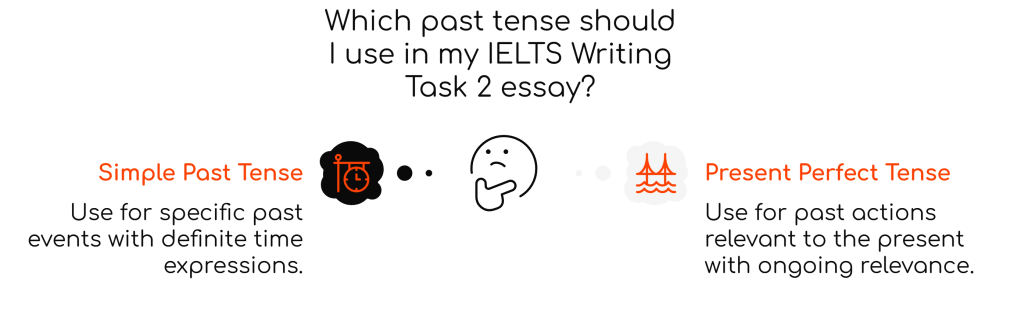
Using the correct verb tense is essential in IELTS Writing Task 2, especially when discussing past events, trends, or research findings. Proper use of past tenses not only enhances grammatical accuracy but also improves coherence and clarity, making your arguments more convincing.
This guide provides a detailed breakdown of past tenses commonly used in IELTS essays, with practical examples and key tips to help you apply them effectively.
1. Simple Past Tense – Describing Specific Past Events
The simple past tense is used for completed actions that took place at a specific time in the past. It is often accompanied by time expressions such as:
- In 1990
- Three years ago
- During the 20th century
Examples in IELTS Contexts:
Education: In 1985, the government implemented a nationwide literacy program to combat illiteracy.
Technology: During the late 1990s, personal computers became widely accessible to the public.
Environment: Three decades ago, numerous countries signed the Kyoto Protocol to combat climate change.
Key IELTS Tip:
Use the simple past tense when referring to a specific past event or year. If an action is linked to a particular time in the past, the simple past is the correct choice rather than the present perfect.
2. Present Perfect Tense – Connecting the Past to the Present
The present perfect tense is used to describe actions or events that began in the past but are still relevant today. Common time expressions associated with this tense include:
- Since 2000
- Over the past decade
- Recently
Examples in IELTS Contexts:
Health: Since 2010, there has been a significant increase in awareness about mental health issues.
Economy: Over the past decade, emerging markets have experienced rapid economic growth.
Social Issues: Recently, debates on income inequality have gained prominence in political discussions.
Key IELTS Tip:
Use the present perfect tense when discussing changes, trends, or ongoing situations that started in the past but continue to have an impact in the present.
3. Referring to Previous Research in Academic Writing
In IELTS essays, especially those on academic topics, referencing previous research is crucial. Choosing between the simple past and the present perfect depends on the context and the emphasis of the statement.
- Use the simple past when referring to a specific study conducted at a definite time in the past:
- Smith (2005) conducted a study on urbanization and its effects on biodiversity.
- Use the present perfect when discussing general research trends or findings that remain relevant:
- Several studies have investigated the correlation between social media usage and mental health.
Key IELTS Tip:
When deciding which tense to use for previous research, consider:
- If the study was conducted at a specific time in the past → Use the simple past
- If the study’s findings are still relevant and applicable today → Use the present perfect
4. Matching Time Expressions with the Correct Tense
Time expressions provide clarity when discussing past events, and selecting the appropriate tense ensures grammatical accuracy.
Use the Simple Past with:
- Between 1990 and 2000, the global population grew at an unprecedented rate.
- In 2015, the United Nations set new sustainability goals.
- Five years ago, social media was not as widely used as it is today.
Use the Present Perfect with:
- In recent years, renewable energy sources have become more cost-effective.
- Over the past decade, e-learning has revolutionized the education sector.
- Since the early 2000s, remote work has gained popularity.
Key IELTS Tip:
Avoid mixing time expressions incorrectly. For example:
❌ Since 2010, scientists discovered new planets.
✔ Instead, write: Since 2010, scientists have discovered new planets.
Why Mastering Past Tenses Matters in IELTS Writing
Effectively using past tenses strengthens your essay by:
- Ensuring grammatical accuracy
- Enhancing clarity and coherence
- Demonstrating a strong command of English
Using the correct tenses allows you to articulate historical events, describe past research, and analyze trends with precision, making your writing more impactful.
Final Thoughts
Mastering past tenses is a crucial skill for IELTS Writing Task 2. By understanding when to use the simple past and present perfect tenses, you can improve the accuracy and credibility of your arguments, ultimately boosting your score.
If you struggle with verb tenses in IELTS writing, practice incorporating these structures into your essays. Over time, correct usage will become second nature, helping you write with greater confidence and fluency.
Would you like more examples or practice exercises on this topic? Share your thoughts in the comments below!
#IELTSGuidePhil #IELTS #IELTSWriting #IELTSVocabulary #IELTSTips #EnglishLearning #StudyAbroad #IELTSPreparation
 IELTS Guide Phil
Leave a comment