
The IELTS Speaking test is a crucial component of the exam, assessing your ability to communicate effectively in English. Many test-takers feel anxious about this part of the test, but with a clear understanding of the format, scoring criteria, and effective strategies, you can boost your confidence and achieve a high band score. This guide provides a structured approach to help you perform at your best.
Understanding the IELTS Speaking Test Structure
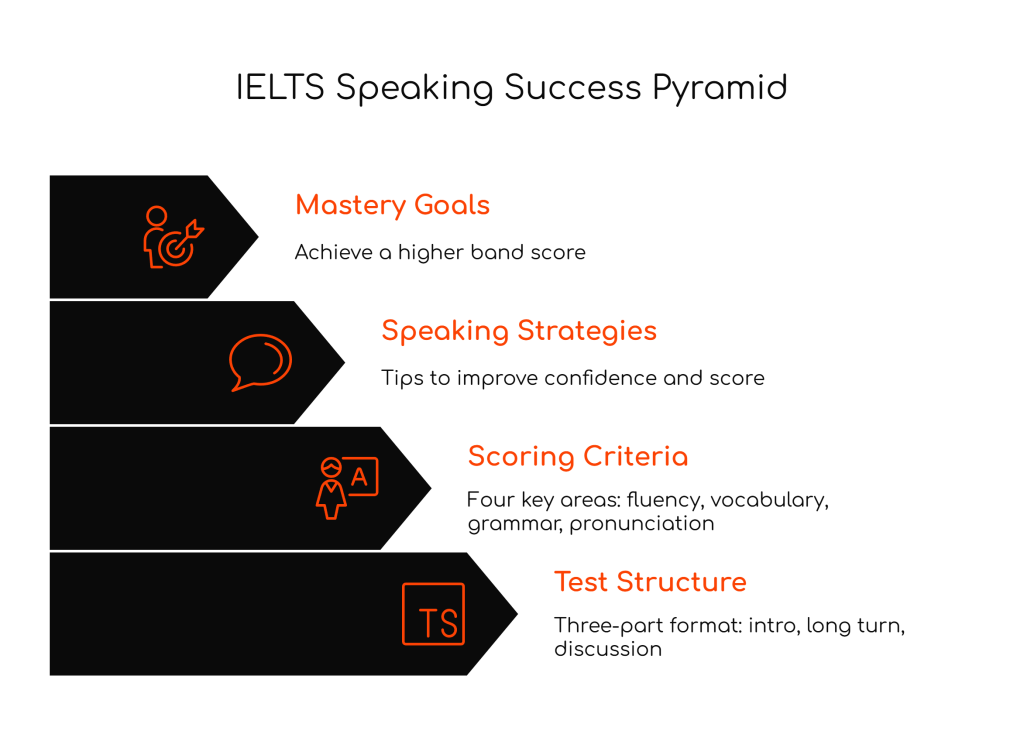
The IELTS Speaking test lasts between 11-14 minutes and consists of three parts:
Part 1: Introduction & Interview (4-5 minutes)
The examiner will ask general questions about yourself, your daily life, work or studies, hobbies, and interests.
- Keep your answers clear, concise, and natural.
- Provide short but informative responses, avoiding one-word answers.
Part 2: Individual Long Turn (3-4 minutes)
You will receive a task card with a topic and one minute to prepare your response. You must speak for up to two minutes, followed by one or two short follow-up questions from the examiner.
- Use the preparation time effectively by organizing your response.
- Cover all points mentioned in the task card.
- Expand your answer with relevant details and examples.
Part 3: Two-Way Discussion (4-5 minutes)
This section involves a more in-depth discussion of abstract and analytical questions related to the Part 2 topic.
- Justify your opinions with examples and reasoning.
- Use a mix of sentence structures to show grammatical range.
- Be prepared for unexpected questions and think critically.
How the IELTS Speaking Test is Scored
Your performance is evaluated based on four key criteria, each contributing 25% to your final band score:
- Fluency & Coherence – The ability to speak smoothly and logically, avoiding long pauses and hesitation.
- Lexical Resource (Vocabulary) – A good range of vocabulary used naturally and appropriately.
- Grammatical Range & Accuracy – The ability to use a variety of sentence structures correctly.
- Pronunciation – Clear and intelligible speech with appropriate stress, rhythm, and intonation.
Effective Strategies to Improve Your IELTS Speaking Score
- Understand the Test Format: Familiarity with the test structure reduces anxiety and improves performance.
- Practice Speaking Naturally: Avoid memorized answers. Instead, focus on expressing your thoughts clearly and spontaneously.
- Expand Your Responses: When answering questions, provide explanations, examples, or personal experiences to develop your response fully.
- Think Quickly & Minimize Pauses: If you struggle to find words, use filler phrases such as “That’s an interesting question” or “Let me think about that for a moment” to gain a few extra seconds to organize your thoughts.
- Use a Simple, Effective Structure: Having a mental framework for answering different question types will help you stay organized.
- Prepare for Common Topics: IELTS frequently covers topics such as education, technology, travel, environment, and culture. Practicing these areas will boost your confidence.
- Focus on Accuracy Over Complexity: It’s better to use simple, correct grammar than to attempt complex structures with frequent mistakes.
Common Misconceptions About the IELTS Speaking Test
- Myth: You must have a British or American accent.
- Fact: The IELTS test accepts all accents as long as pronunciation is clear and understandable.
- Myth: Your ideas need to be unique or impressive.
- Fact: You are scored on your language ability, not the originality of your ideas.
- Myth: Body language and eye contact affect your score.
- Fact: Unlike job interviews, the IELTS Speaking test assesses only verbal communication skills.
Final Tips for IELTS Speaking Success
- Practice speaking aloud daily – Engage in conversations, record yourself, or join an English-speaking club.
- Listen to native speakers – Watch English news, podcasts, and TED Talks to familiarize yourself with natural speech patterns.
- Simulate test conditions – Practice under timed conditions to build confidence.
- Seek feedback – Have a tutor or friend evaluate your performance and suggest improvements.
Conclusion
The IELTS Speaking test may seem intimidating, but with regular practice and the right strategies, you can achieve a high band score. Focus on fluency, vocabulary, grammar, and pronunciation to enhance your performance. Confidence and preparation are key to success.
Need personalized coaching? Drop your questions in the comments or contact us for expert IELTS guidance.
#IELTSGuidePhil #IELTS #IELTSPreparation #IELTSGuide #StudyAbroad #EnglishProficiency #IELTSTips #IELTSExam #TestPreparation #IELTSAcademic #IELTSGeneralTraining #LanguageTesting #IELTSSpeaking
 IELTS Guide Phil
Leave a comment