
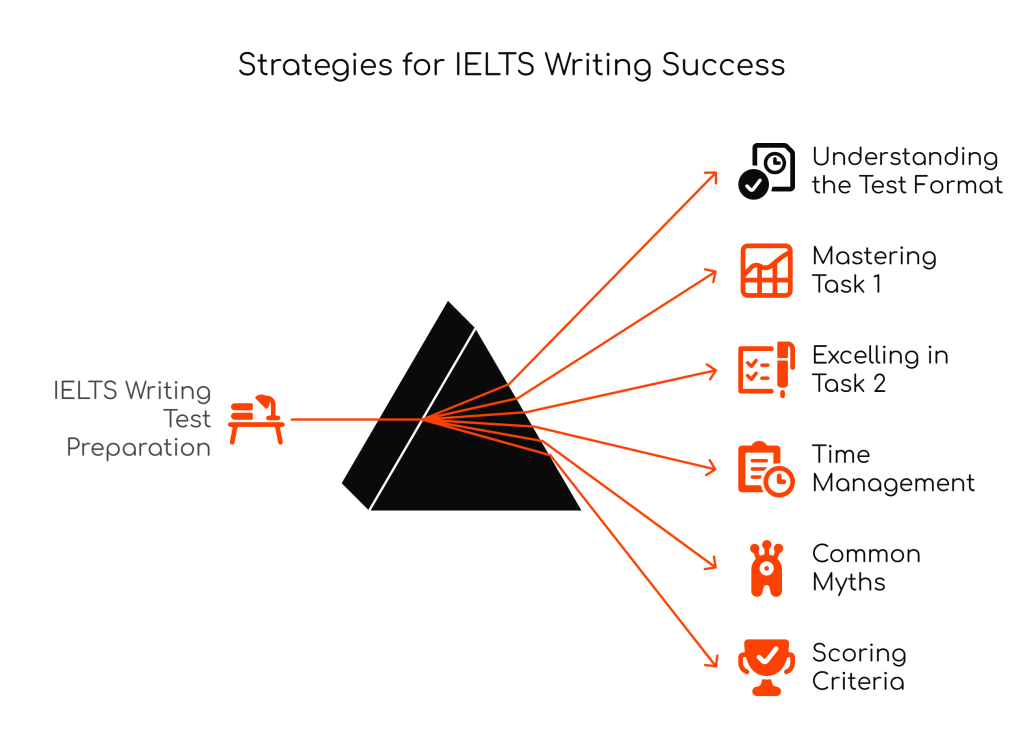
The IELTS Writing test is one of the most challenging components for many test-takers. Common difficulties include time management, structuring responses effectively, and maintaining clarity. Additionally, misconceptions about the test often lead to strategies that can negatively impact scores. This guide will provide a structured approach to mastering the IELTS Writing test and maximizing performance.
Understanding the IELTS Writing Test Format
The Writing test lasts for 60 minutes and consists of two tasks:
- Task 1 (20 minutes): Report writing (Academic) or letter writing (General Training)
- Task 2 (40 minutes): Essay writing (for both Academic and General Training)
Key Points to Remember:
- Task 2 contributes twice as many marks as Task 1, making effective time management essential.
- There is no benefit to exceeding the word limit significantly; clarity and accuracy are more important than length.
Dispelling Common IELTS Writing Myths
Myth: “Writing More Words Leads to a Higher Score”
Excessively long responses do not necessarily yield better results. Writing beyond 150 words (Task 1) or excessively more than 250 words (Task 2) may:
- Increase the risk of grammatical errors
- Lead to off-topic content
- Leave less time for proofreading
Myth: “Using Complex Vocabulary and Sentences Always Impresses Examiners”
While a diverse vocabulary is important, forced complexity can hinder clarity. Effective writing balances accuracy, coherence, and lexical variety rather than prioritizing difficult words or overly long sentences.
Mastering IELTS Writing Task 1
Academic Writing Task 1: Analyzing and Summarizing Visual Data
Academic Task 1 requires test-takers to describe and summarize visual data presented in various formats:
- Graphs
- Charts
- Tables
- Processes
- Maps
Strategies for Success:
- Identify and summarize key trends rather than analyzing every detail.
- Compare significant increases, decreases, and patterns.
- Structure the response logically, ensuring clarity and conciseness.
The Importance of an Overview
The overview serves as a summary of the main trends or key points in the data. It should:
- Be concise (one to two sentences)
- Appear at the beginning or end of the response
- Highlight the most notable patterns
General Training Writing Task 1: Letter Writing
General Training Task 1 involves writing a letter based on a given situation. Letters fall into three categories:
- Formal (e.g., complaint letters, job applications)
- Semi-formal (e.g., letter to a colleague)
- Informal (e.g., letter to a friend)
Key Tip: Adjust the tone and language based on the recipient. Formal letters require professional language, whereas informal letters allow for a more conversational approach.
Excelling in IELTS Writing Task 2: Essay Writing
Task 2 requires test-takers to write a structured essay in response to a prompt. The most common essay types include:
- Opinion (Agree/Disagree): Clearly state and support a viewpoint.
- Discussion: Present both perspectives before giving an opinion.
- Advantages & Disadvantages: Analyze both benefits and drawbacks.
- Problem & Solution: Identify an issue and propose solutions.
- Two-Part Question: Address two related questions in a single response.
Structuring a High-Scoring Essay
A well-structured essay follows this format:
- Introduction: Paraphrase the question and present the thesis statement.
- Body Paragraph 1: Main point, explanation, and example.
- Body Paragraph 2: Another key point, explanation, and example.
- Conclusion: Summarize key arguments and provide a final thought.
Using Linking Words for Coherence
Logical connections between ideas improve clarity and readability. Consider using:
- To add a point: Furthermore, Moreover, In addition
- To contrast: However, On the other hand, Nevertheless
- To provide examples: For example, Such as, Namely
- To conclude: In conclusion, To summarize, Overall
How IELTS Writing Is Scored
IELTS Writing responses are assessed based on four criteria:
- Task Achievement: Does the response fully address the question?
- Coherence & Cohesion: Is the essay well-organized and logically structured?
- Lexical Resource: Does the response use appropriate vocabulary and collocations?
- Grammar & Accuracy: Are sentences grammatically correct and varied?
Grammar Tip: Use a mix of simple and complex sentences to demonstrate a strong command of English.
Final Tips for IELTS Writing Success
- Read the prompt carefully to avoid misinterpreting the question.
- Create a brief outline before writing to maintain a logical structure.
- Use clear and concise language—avoid unnecessary complexity.
- Vary vocabulary by incorporating synonyms and collocations.
- Proofread responses to correct grammar mistakes and awkward phrasing.
Regular practice in writing reports, letters, and essays—along with feedback—can significantly enhance performance. By applying these strategies, test-takers can develop the skills needed to excel in the IELTS Writing test.
By mastering key strategies and maintaining a structured approach, achieving a high band score in IELTS Writing is entirely possible. What challenges do you face in IELTS Writing? Share your thoughts and questions below!
#IELTSGuidePhil #IELTS #IELTSPreparation #IELTSGuide #StudyAbroad #EnglishProficiency #IELTSTips #IELTSExam #TestPreparation #IELTSAcademic #IELTSGeneralTraining #LanguageTesting #IELTSWriting
 IELTS Guide Phil
Leave a comment