
Many IELTS candidates find the Reading test challenging. However, with the appropriate strategies and consistent practice, achieving a high score is entirely possible. This guide provides a structured approach to understanding the test format, recognizing question types, and applying effective reading techniques.
Understanding the IELTS Reading Test Format
Before employing any strategies, it is essential to understand the structure of the IELTS Reading test:
- Duration: 60 minutes (no additional time for transferring answers)
- Number of Passages: Three sections in the Academic module; a combination of short and long texts in the General Training module
- Total Questions: 40 questions, each worth one mark
- Scoring: No penalties for incorrect answers; guessing is encouraged when uncertain
Differences Between Academic and General Training Reading Tests
- Academic IELTS: Includes three long passages extracted from books, journals, and research articles.
- General Training IELTS: Comprises shorter texts in the first two sections (e.g., advertisements, brochures, workplace documents), while the third section presents a more complex passage.
Common Question Types and Strategies
The IELTS Reading test includes various question types, which can be categorized as follows:
- Completion Questions (Fill in the Blanks)
- Includes note, table, flowchart, and summary completion
- Strategy: Identify keywords and locate their synonyms in the passage
- Matching Questions
- Includes matching headings, information, and sentence endings
- Strategy: Focus on the first and last sentence of each paragraph to grasp the main idea
- True/False/Not Given or Yes/No/Not Given
- True: The statement agrees with the passage.
- False: The statement contradicts the passage.
- Not Given: The passage does not contain enough information to determine an answer.
- Strategy: Avoid assumptions; rely solely on information presented in the text.
- Multiple-Choice and Short-Answer Questions
- Strategy: Expect paraphrased versions of the answer choices in the text rather than identical wording.
Effective Time Management Techniques
Time management is crucial for success in the Reading test. Common pitfalls include spending too much time on a single question. To optimize time allocation:
- Aim to spend approximately 20 minutes per passage and 90 seconds per question before moving forward.
- If a question appears too difficult, skip it and return later.
- Answer all questions, even if uncertain, as there is no penalty for incorrect responses.
- Transfer answers progressively, as no extra time is provided for this task.
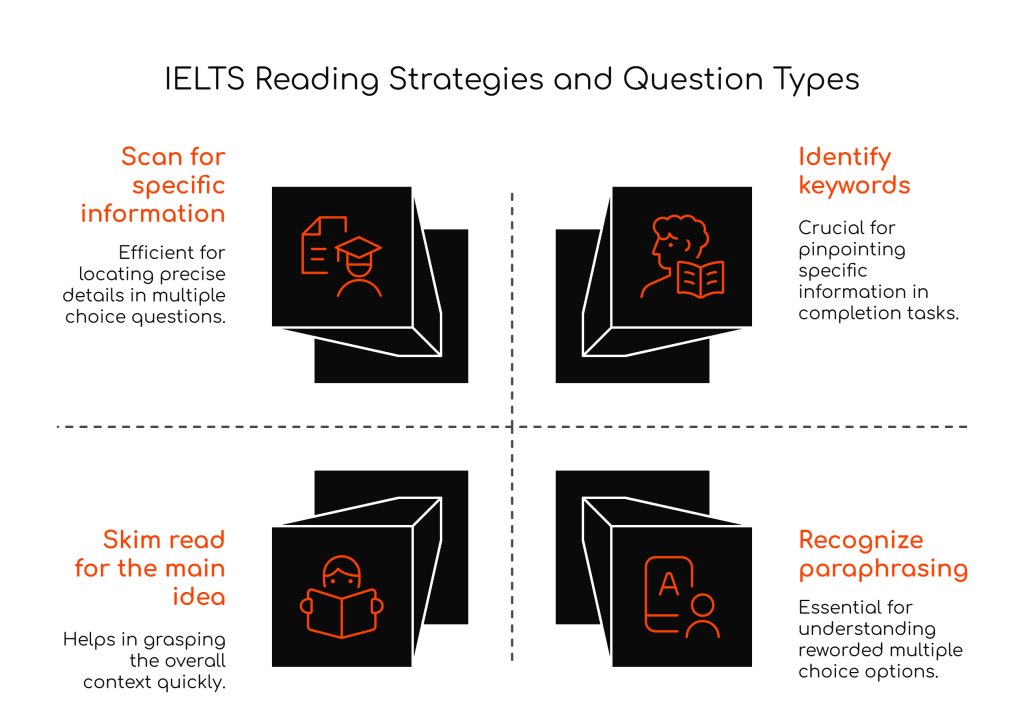
Five Key Strategies for Improving IELTS Reading Performance
- Skim for the Main Idea
- Read the passage quickly to understand its structure before focusing on details.
- Identify Keywords and Synonyms
- Since the exact words from the question may not appear in the text, look for paraphrased phrases.
- Scan for Specific Information
- Use numbers, names, dates, and capitalized words as reference points for locating answers.
- Recognize Paraphrasing
- IELTS often rewords concepts; practice identifying synonyms and sentence rephrasings.
- Expand Vocabulary
- A broad vocabulary enhances reading speed and comprehension, making it easier to interpret paraphrased questions.
Expert Tips from IELTS Examiners
- Familiarize yourself with the strategies for each question type.
- Read both the passage and the questions before searching for answers.
- Manage time efficiently; avoid spending excessive time on a single question.
- For Matching Headings: Focus on the first and last sentence of each paragraph and summarize key points in your own words.
- For Faster Reading: Regularly read news articles and summarize their main ideas.
- For ‘Not Given’ Questions: Ask whether sufficient information exists to confirm a statement. If not, the correct response is Not Given.
Final Steps to Achieving a High Score
- Practice with Timed Tests: Simulate real exam conditions.
- Identify Weak Areas: Focus on improving difficult question types such as Matching Headings and True/False/Not Given.
- Read Regularly: Engage with a variety of texts, including newspapers, academic papers, and journals, to build reading fluency.
- Enhance Synonym Recognition: IELTS frequently employs paraphrasing, making vocabulary expansion crucial.
Success in the IELTS Reading test is not merely a matter of intelligence but rather the application of strategic techniques. With diligent preparation and a structured approach, test-takers can significantly improve their scores and achieve their desired band.
For any further inquiries regarding the IELTS Reading test, feel free to leave a comment below.
#IELTSGuidePhil #IELTS #IELTSPreparation #IELTSGuide #StudyAbroad #EnglishProficiency #IELTSTips #IELTSExam #TestPreparation #IELTSAcademic #IELTSGeneralTraining #LanguageTesting #IELTSReading
 IELTS Guide Phil
Leave a comment