
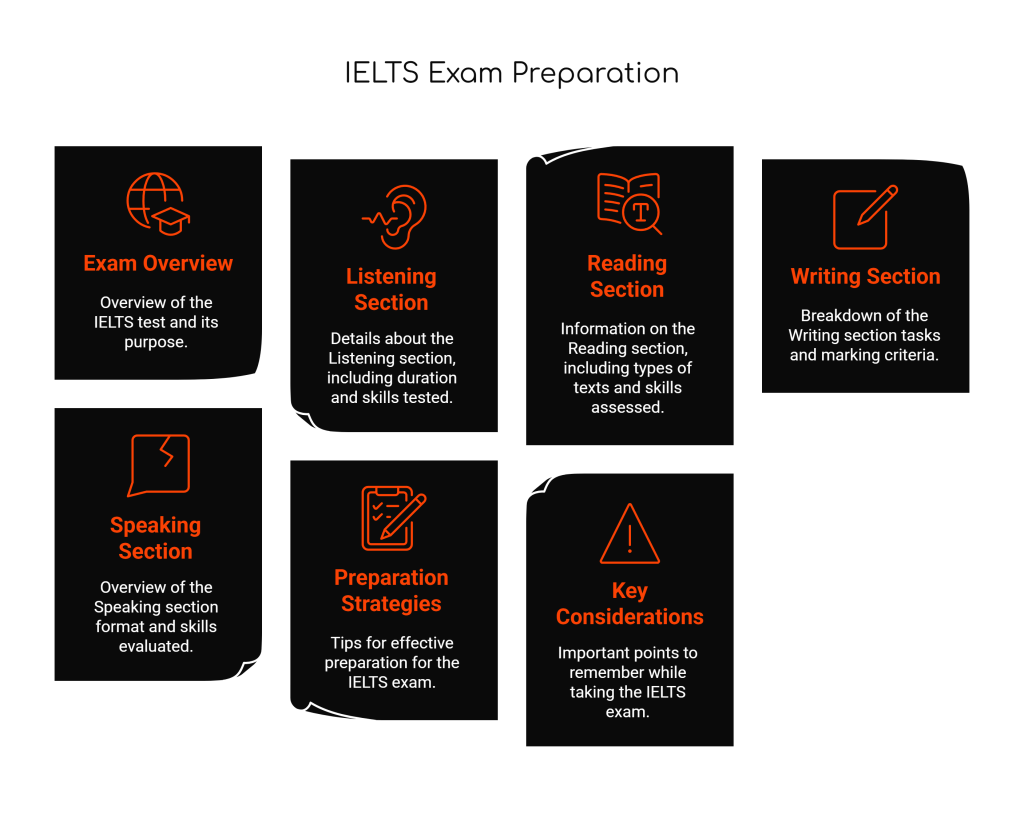
The International English Language Testing System (IELTS) is a globally recognized exam designed to assess English language proficiency. Whether you are aiming to study abroad, migrate to an English-speaking country, or advance in your professional career, achieving a high IELTS score can open doors to numerous opportunities. This comprehensive guide provides an in-depth look at the IELTS exam, including its structure, key strategies for success, and essential preparation tips.
1. Overview of the IELTS Exam
IELTS evaluates four key language skills: Listening, Reading, Writing, and Speaking. Recognized by universities, employers, and immigration authorities worldwide, the exam is available in two versions:
- Academic IELTS: Designed for individuals seeking higher education or professional registration.
- General Training IELTS: Suitable for those migrating to an English-speaking country or applying for non-degree level education or training programs.
Note: The Listening and Speaking sections are identical in both versions, while the Reading and Writing sections differ.
2. Detailed Breakdown of IELTS Sections
A. Listening
- Duration: 30 minutes (plus 10 minutes for answer transfer).
- Content: Four sections featuring two everyday social interactions and two educational or training-related conversations.
- Question Types: Multiple-choice, matching, diagram labeling, form completion, among others.
- Accents: Exposure to British, American, Australian, and New Zealand accents.
- Skills Assessed: Ability to identify main ideas, specific details, speaker relationships, and logical progression of conversations.
Tip: The answers appear in order within the recording—follow along carefully to avoid missing key details.
B. Reading
- Duration: 60 minutes (no extra time for answer transfer).
- Academic IELTS: Features texts from books, journals, and newspapers relevant to university students.
- General Training IELTS: Includes everyday texts (e.g., advertisements, work-related documents, and general interest articles).
- Question Types: True/False/Not Given, matching headings, summary completion, and more.
- Skills Assessed: Skimming, scanning, detailed comprehension, and understanding the author’s intent.
Key Difference: The Academic module presents more formal and complex reading materials, while the General Training version focuses on practical, real-world contexts.
C. Writing
- Duration: 60 minutes (Task 1: 20 minutes, Task 2: 40 minutes).
- Academic IELTS:
- Task 1: Interpretation of visual data (graphs, charts, or diagrams).
- Task 2: Argumentative or analytical essay response to a prompt.
- General Training IELTS:
- Task 1: Writing a formal, semi-formal, or informal letter.
- Task 2: A structured essay responding to a given topic, similar to the Academic module.
- Assessment Criteria: Task achievement, coherence and cohesion, lexical resource, grammatical range, and accuracy.
Tip: Task 2 contributes more to the overall Writing score—allocate sufficient time and effort accordingly.
D. Speaking
- Duration: 11-14 minutes (face-to-face interview with an examiner).
- Parts:
- Part 1: Introduction and general conversation.
- Part 2: A two-minute monologue based on a given topic.
- Part 3: Discussion on abstract issues related to Part 2.
- Skills Assessed: Fluency, coherence, pronunciation, vocabulary usage, and grammatical accuracy.
Tip: Speak naturally and clearly. Focus on coherence rather than memorized answers.
3. Assessment Criteria and Band Scores
IELTS Band Score Scale
- Band 9: Expert User
- Band 8: Very Good User
- Band 7: Good User
- Band 6: Competent User
- Band 5: Modest User
- Band 4: Limited User
- Band 3: Extremely Limited User
- Band 2: Intermittent User
- Band 1: Non-User
- Band 0: Did not attempt the test
Marking Criteria
Each section is scored based on the following criteria:
- Listening & Reading: Number of correct answers.
- Writing: Task achievement, coherence and cohesion, lexical resource, grammatical range and accuracy.
- Speaking: Fluency and coherence, lexical resource, grammatical range and accuracy, pronunciation.
4. Dos and Don’ts
Dos:
✔ Read all instructions carefully.
✔ Manage your time effectively.
✔ Use formal language in Writing Task 2.
✔ Listen for keywords in the Listening section.
✔ Review your answers before submission.
Don’ts:
✘ Don’t write below the word limit.
✘ Don’t panic if you don’t understand a word—focus on context.
✘ Don’t memorize responses in the Speaking section.
✘ Don’t leave any question unanswered.
✘ Don’t use overly complex words incorrectly.
5. Common Mistakes and Fixes
| Mistake | Solution |
|---|---|
| Writing off-topic essays | Analyze the question carefully before writing. |
| Misinterpreting True/False/Not Given | Focus on what is explicitly stated in the passage. |
| Running out of time | Practice under timed conditions. |
| Not supporting ideas in Writing Task 2 | Use specific examples and explanations. |
| Speaking too quickly due to nervousness | Practice pacing and take brief pauses. |
6. Frequently Asked Questions (FAQs)
Q: How long is my IELTS score valid?
A: IELTS scores are valid for two years from the test date.
Q: How often can I take the IELTS exam?
A: You can take the test as many times as you want, but it is recommended to prepare well before retaking.
Q: What is the passing score for IELTS?
A: There is no pass or fail; institutions and organizations set their own required band scores.
Q: Can I use American spelling in the Writing section?
A: Yes, both American and British spellings are accepted, but be consistent.
Q: When will I receive my IELTS results?
A: Results are available online 13 days after the test date.
7. Test Registration and Results
- Registration: Sign up via the official IELTS website or an authorized test center.
- Test Fees: Fees vary by country; check your local test center’s website.
- Test Dates: IELTS is conducted multiple times a month; choose a date that suits your preparation timeline.
- Receiving Results:
- Online: Available in 13 days (for paper-based tests) or 3-5 days (for computer-based tests).
- Physical Copy: Mailed to test-takers; delivery time varies by location.
Conclusion
Success in the IELTS exam requires a thorough understanding of its format, consistent practice, and strategic preparation. By focusing on skill development and familiarizing yourself with test requirements, you can achieve your desired score and move closer to your academic, professional, or migration goals.
Are you preparing for the IELTS? Share your thoughts and experiences in the comments below!
#IELTSGuidePhil #IELTS #IELTSPreparation #IELTSGuide #StudyAbroad #EnglishProficiency #IELTSTips #IELTSExam #TestPreparation #IELTSAcademic #IELTSGeneralTraining #LanguageTesting
 IELTS Guide Phil
Leave a comment